
Blog
Object Oriented Programming Past Paper 2026 AD/BS 2nd Semester UOS (CMPC-5202)
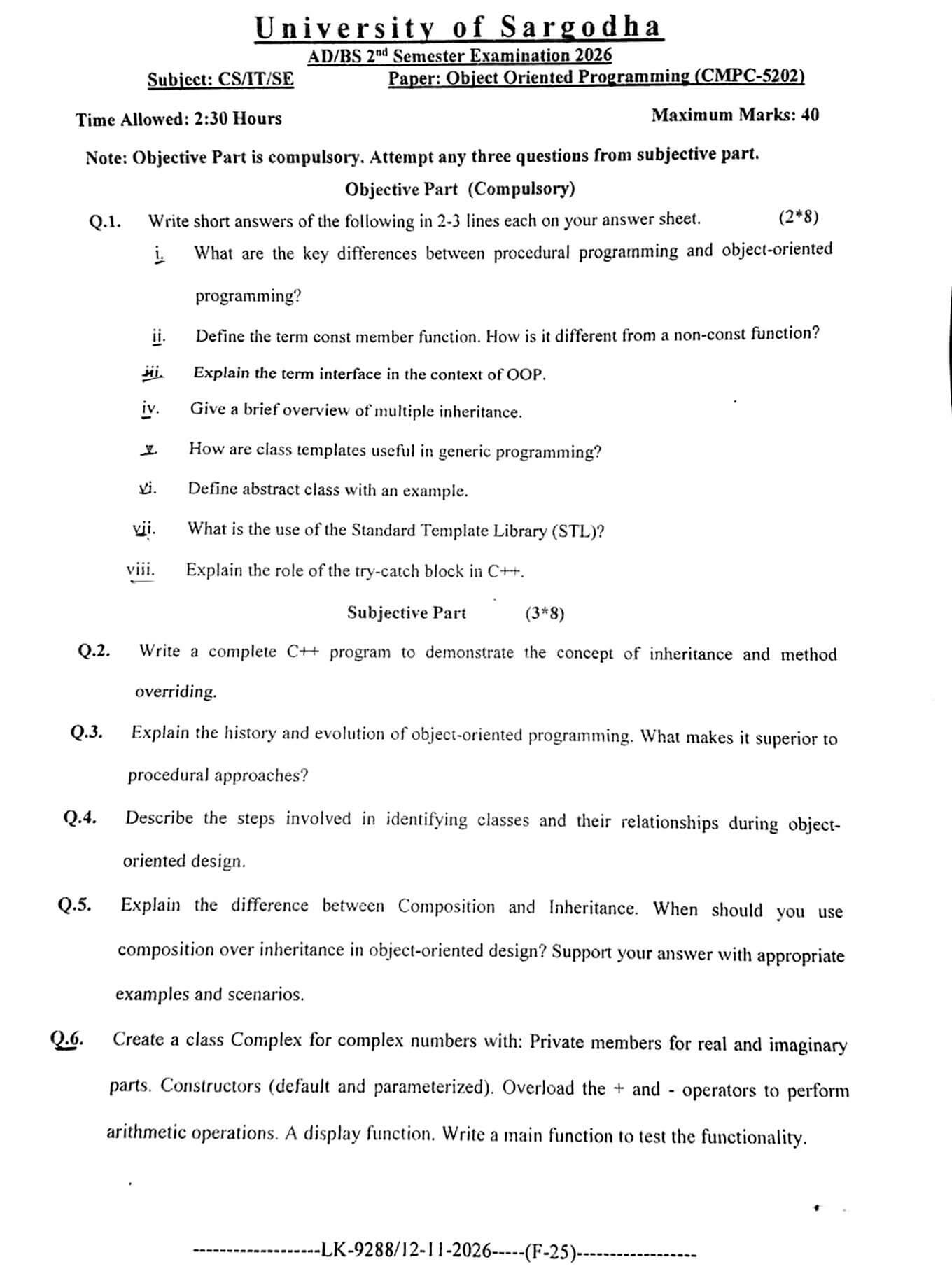
University of Sargodha (UOS) AD/BS 2nd semester Object Oriented Programming (CMPC-5202) past paper 2026 for CS, IT and SE, held in November 2026 – with the full question paper in text form and solved answers. All C++ programs are tested.
OOP Past Paper 2026 (text version)
University of Sargodha – AD/BS 2nd Semester Examination 2026, CS/IT/SE
Paper: Object Oriented Programming (CMPC-5202) · Time: 2:30 hours · Maximum marks: 40
Note: Objective part is compulsory. Attempt any three questions from the subjective part.
Objective part (compulsory, 2 × 8)
- What are the key differences between procedural programming and object-oriented programming?
- Define the term const member function. How is it different from a non-const function?
- Explain the term interface in the context of OOP.
- Give a brief overview of multiple inheritance.
- How are class templates useful in generic programming?
- Define abstract class with an example.
- What is the use of the Standard Template Library (STL)?
- Explain the role of the try-catch block in C++.
Subjective part (attempt any three, 3 × 8)
- Q.2 Write a complete C++ program to demonstrate the concept of inheritance and method overriding.
- Q.3 Explain the history and evolution of object-oriented programming. What makes it superior to procedural approaches?
- Q.4 Describe the steps involved in identifying classes and their relationships during object-oriented design.
- Q.5 Explain the difference between composition and inheritance. When should you use composition over inheritance in object-oriented design? Support your answer with appropriate examples and scenarios.
- Q.6 Create a class Complex for complex numbers with: private members for real and imaginary parts; constructors (default and parameterized); overloaded + and − operators to perform arithmetic operations; a display function. Write a main function to test the functionality.
Solved answers – OOP 2026
Short questions
- Procedural programming organizes a program as functions working on shared data (top-down, e.g. C); data is exposed and hard to protect. OOP organizes it as objects that combine data and functions (bottom-up, e.g. C++, Java), giving encapsulation, inheritance and polymorphism – better data security, reuse and maintenance for large programs.
- A const member function is declared with
constafter its parameter list and promises not to modify the object’s data members. It can be called on const objects; a non-const function can change members and cannot be called on a const object.class Point { int x; public: int getX() const { return x; } // const: cannot modify x void setX(int v) { x = v; } // non-const: may modify }; const Point p; // p.getX() allowed, p.setX(5) is an error - An interface is a contract listing operations a class must provide, without implementation. In C++ it is an abstract class with only pure virtual functions; derived classes implement them, so code can depend on the interface instead of concrete classes (e.g. a
Printableinterface withprint()). - Multiple inheritance: a class derives from two or more base classes and inherits members of all of them –
class C : public A, public B { };. It enables combining features but can cause ambiguity and the diamond problem, which is solved with virtual inheritance. - Class templates let one class definition work with any data type – the type is a parameter. This avoids rewriting the same class for int, double or string and keeps type safety (the STL containers are templates).
template <typename T> class Box { T value; public: Box(T v) : value(v) {} T get() const { return value; } }; Box<int> a(5); Box<string> b("UOS"); // one class, many types - An abstract class has at least one pure virtual function, so it cannot be instantiated; it defines a common interface for derived classes.
class Shape { // abstract class public: virtual double area() const = 0; // pure virtual function }; class Square : public Shape { double s; public: Square(double a) : s(a) {} double area() const override { return s * s; } }; // Shape sh; -> error: cannot create an object of an abstract class - The STL provides ready-made, tested generic components: containers (vector, list, map, set, stack, queue), algorithms (sort, find, count, reverse) and iterators that connect them – saving time and giving efficient, reusable code.
- try-catch handles run-time errors: code that may fail goes in
try, an error is signalled withthrow, and a matchingcatchhandles it, so the program can recover instead of crashing.try { if (d == 0) throw runtime_error("Division by zero"); cout << n / d; } catch (const exception& e) { cout << "Error: " << e.what() << endl; }
Subjective questions (programs compiled and tested with g++)
Q.2 Inheritance and method overriding
#include <iostream>
#include <string>
using namespace std;

class Employee {                       // base class
protected:
    string name;
    double baseSalary;
public:
    Employee(string n, double s) : name(n), baseSalary(s) {}
    virtual double salary() const { return baseSalary; }
    virtual void show() const {
        cout << "Employee: " << name << ", Salary: " << salary() << endl;
    }
    virtual ~Employee() {}
};

class Manager : public Employee {      // derived class (inheritance)
    double bonus;
public:
    Manager(string n, double s, double b) : Employee(n, s), bonus(b) {}
    double salary() const override { return baseSalary + bonus; }   // overriding
    void show() const override {
        cout << "Manager: " << name << ", Salary: " << salary()
             << " (includes bonus " << bonus << ")" << endl;
    }
};

class Intern : public Employee {
public:
    Intern(string n, double s) : Employee(n, s) {}
    double salary() const override { return baseSalary * 0.5; }    // overriding
    void show() const override {
        cout << "Intern: " << name << ", Stipend: " << salary() << endl;
    }
};

int main() {
    Employee* staff[3] = {
        new Employee("Ali", 80000),
        new Manager("Sara", 120000, 30000),
        new Intern("Hamza", 40000)
    };
    for (Employee* e : staff) {
        e->show();          // the overridden version runs (run-time polymorphism)
        delete e;
    }
    return 0;
}
Output: Employee: Ali, Salary: 80000 / Manager: Sara, Salary: 150000 (includes bonus 30000) / Intern: Hamza, Stipend: 20000. Manager and Intern inherit name and baseSalary from Employee and override salary() and show(); because the base functions are virtual, calls through an Employee* run the derived versions.
Q.3 History and evolution of OOP:
- 1960s – Simula 67 (Ole-Johan Dahl and Kristen Nygaard, Norway) introduced classes, objects and inheritance for simulation programs.
- 1970s – Smalltalk (Alan Kay, Xerox PARC) made “everything an object” with message passing, and coined the term object-oriented.
- 1980s – C++ (Bjarne Stroustrup, 1983–85) added classes to C; Objective-C and Eiffel followed.
- 1990s – Java (1995) made OOP mainstream with platform independence; Python and Ruby also became popular; UML (1997) standardized OO design.
- 2000s onwards – C#, modern C++ (11/14/17/20), Kotlin, Swift combine OOP with generic and functional features.
Why it is superior to procedural approaches: encapsulation protects data from accidental change; abstraction hides complexity; inheritance and composition give code reuse; polymorphism lets one interface work with many types; and modelling real-world entities as objects makes large programs easier to design, test, maintain and extend, with teams working on separate classes.
Q.4 Steps for identifying classes and their relationships:
- Understand the requirements – read the problem statement and use cases.
- Find candidate classes – underline the nouns (noun-phrase analysis), e.g. in a library system: Book, Member, Librarian, Loan.
- Filter the candidates – remove duplicates, vague terms, and nouns that are only attributes (title, date).
- Identify attributes – the data each class must hold.
- Identify operations – verbs become methods (issueBook(), returnBook()); use CRC cards (Class–Responsibility–Collaborator).
- Identify relationships – association (Member borrows Book), aggregation/composition (Library has Books), inheritance (Student and Teacher are Members) and dependency, with multiplicities (1, 0..*, 1..*).
- Draw the class diagram in UML and refine it iteratively – check cohesion, coupling and missing responsibilities.
Q.5 Composition vs inheritance: Inheritance is an “is-a” relationship – a derived class reuses and extends a base class (a Car is a Vehicle); it is fixed at compile time and tightly couples child to parent. Composition is a “has-a” relationship – a class contains objects of other classes as members (a Car has an Engine); the part can be replaced and is reused through its public interface, giving looser coupling.
class Engine { public: void start() { /* ... */ } };
class Car {                 // composition: Car has-an Engine
    Engine engine;
public:
    void drive() { engine.start(); }
};
class ElectricCar : public Car { };   // inheritance: ElectricCar is-a Car
Use composition when: the relationship is “has-a” or “uses-a”; behaviour must change at run time (e.g. a Character with a replaceable Weapon object, or a Printer with interchangeable output strategies); you want to reuse a class without exposing its whole interface; or deep inheritance hierarchies would become fragile (a change in a base class breaks many subclasses). Use inheritance only for true “is-a” relationships where polymorphism is needed. Guideline: favour composition over inheritance.
Q.6 Complex class with + and − operators
#include <iostream>
using namespace std;

class Complex {
private:
    double real, imag;
public:
    Complex() : real(0), imag(0) {}                       // default constructor
    Complex(double r, double i) : real(r), imag(i) {}     // parameterized constructor

    Complex operator+(const Complex& c) const {
        return Complex(real + c.real, imag + c.imag);
    }
    Complex operator-(const Complex& c) const {
        return Complex(real - c.real, imag - c.imag);
    }
    void display() const {
        cout << real << (imag < 0 ? " - " : " + ") << (imag < 0 ? -imag : imag) << "i" << endl;
    }
};

int main() {
    Complex c1(4, 5), c2(2, -3), c3;
    cout << "c1 = "; c1.display();
    cout << "c2 = "; c2.display();
    c3 = c1 + c2;
    cout << "c1 + c2 = "; c3.display();     // 6 + 2i
    c3 = c1 - c2;
    cout << "c1 - c2 = "; c3.display();     // 2 + 8i
    Complex zero;
    cout << "default = "; zero.display();   // 0 + 0i
    return 0;
}
Output: c1 = 4 + 5i, c2 = 2 − 3i, c1 + c2 = 6 + 2i, c1 − c2 = 2 + 8i, default = 0 + 0i.
Answers prepared by Shining Study for revision. Check them against your class notes and teacher’s guidance.