
Blog
Linear Algebra Past Paper 2019 – UOS (Solved)
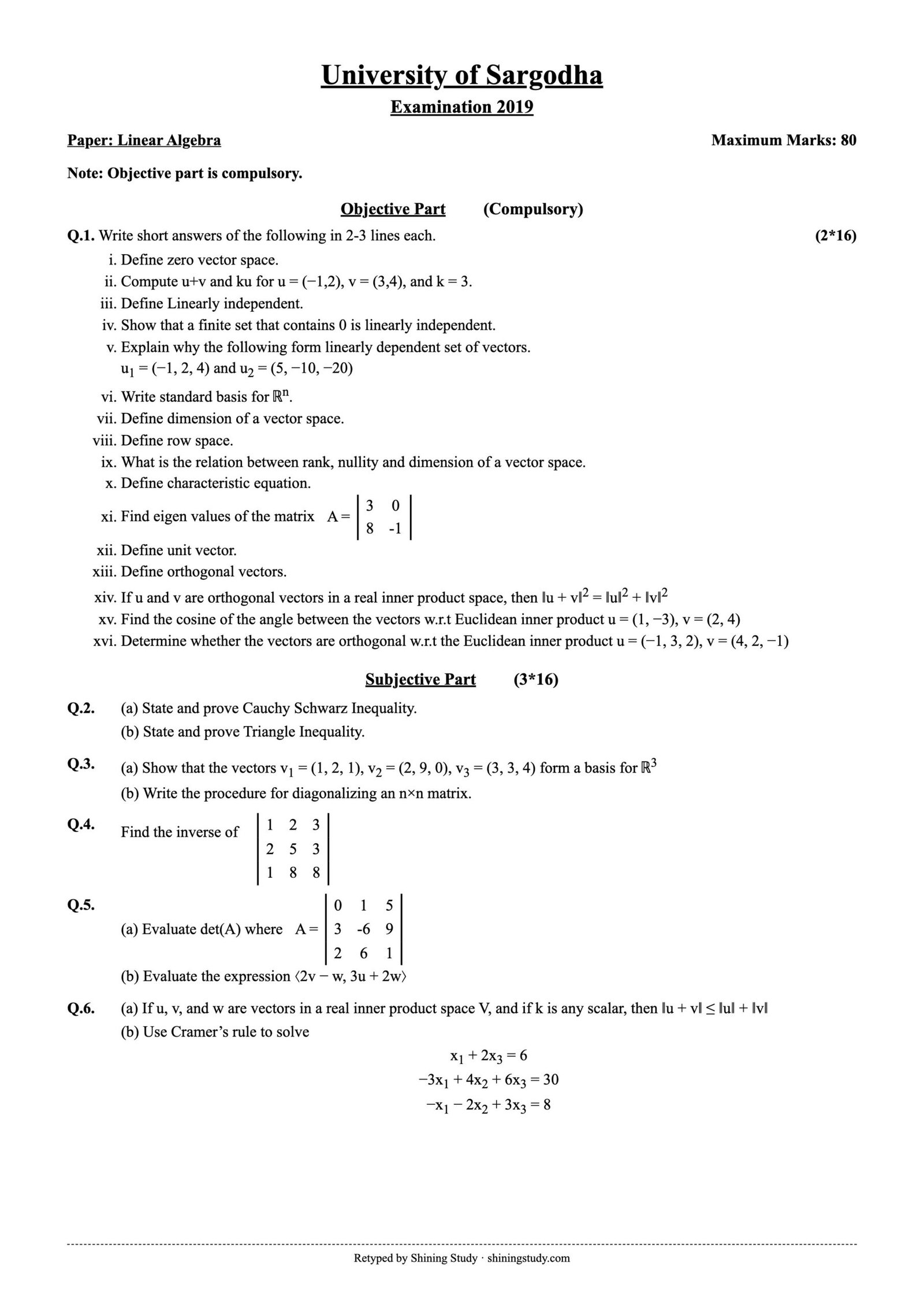
University of Sargodha (UOS) Linear Algebra past paper 2019, with the full question paper in text form and step-by-step solved answers. All determinants, the inverse and the Cramer’s rule solution are checked with code.
Print / download (A4, high quality): Full-size paper
Linear Algebra Past Paper 2019 (text version)
University of Sargodha – Examination 2019, Subject: (not visible in our copy)
Paper: Linear Algebra · Time: not visible in our copy · Maximum marks: 80
Note: Objective part is compulsory.
The top of the original photo (programme, term, course code and time) is cut off; the year is from the source of the paper.
Objective part – Q1: Write short answers of the following in 2-3 lines each. (2*16)
- Define zero vector space.
- Compute u+v and ku for u = (−1,2), v = (3,4), and k = 3.
- Define Linearly independent.
- Show that a finite set that contains 0 is linearly independent.
- Explain why the following form linearly dependent set of vectors.
u1 = (−1, 2, 4) and u2 = (5, −10, −20) - Write standard basis for ℝn.
- Define dimension of a vector space.
- Define row space.
- What is the relation between rank, nullity and dimension of a vector space.
- Define characteristic equation.
- Find eigen values of the matrix A =
3 0 8 -1 - Define unit vector.
- Define orthogonal vectors.
- If u and v are orthogonal vectors in a real inner product space, then ‖u + v‖2 = ‖u‖2 + ‖v‖2
- Find the cosine of the angle between the vectors w.r.t Euclidean inner product u = (1, −3), v = (2, 4)
- Determine whether the vectors are orthogonal w.r.t the Euclidean inner product u = (−1, 3, 2), v = (4, 2, −1)
Subjective part (3*16)
Q2. (a) State and prove Cauchy Schwarz Inequality.
(b) State and prove Triangle Inequality.
Q3. (a) Show that the vectors v1 = (1, 2, 1), v2 = (2, 9, 0), v3 = (3, 3, 4) form a basis for ℝ3
(b) Write the procedure for diagonalizing an n×n matrix.
Q4. Find the inverse of 1 2 3 2 5 3 1 8 8
Q5. (a) Evaluate det(A) where A =0 1 5 3 -6 9 2 6 1
(b) Evaluate the expression ⟨2v − w, 3u + 2w⟩
Q6. (a) If u, v, and w are vectors in a real inner product space V, and if k is any scalar, then ‖u + v‖ ≤ ‖u‖ + ‖v‖
(b) Use Cramer’s rule to solve
−3x1 + 4x2 + 6x3 = 30
−x1 − 2x2 + 3x3 = 8
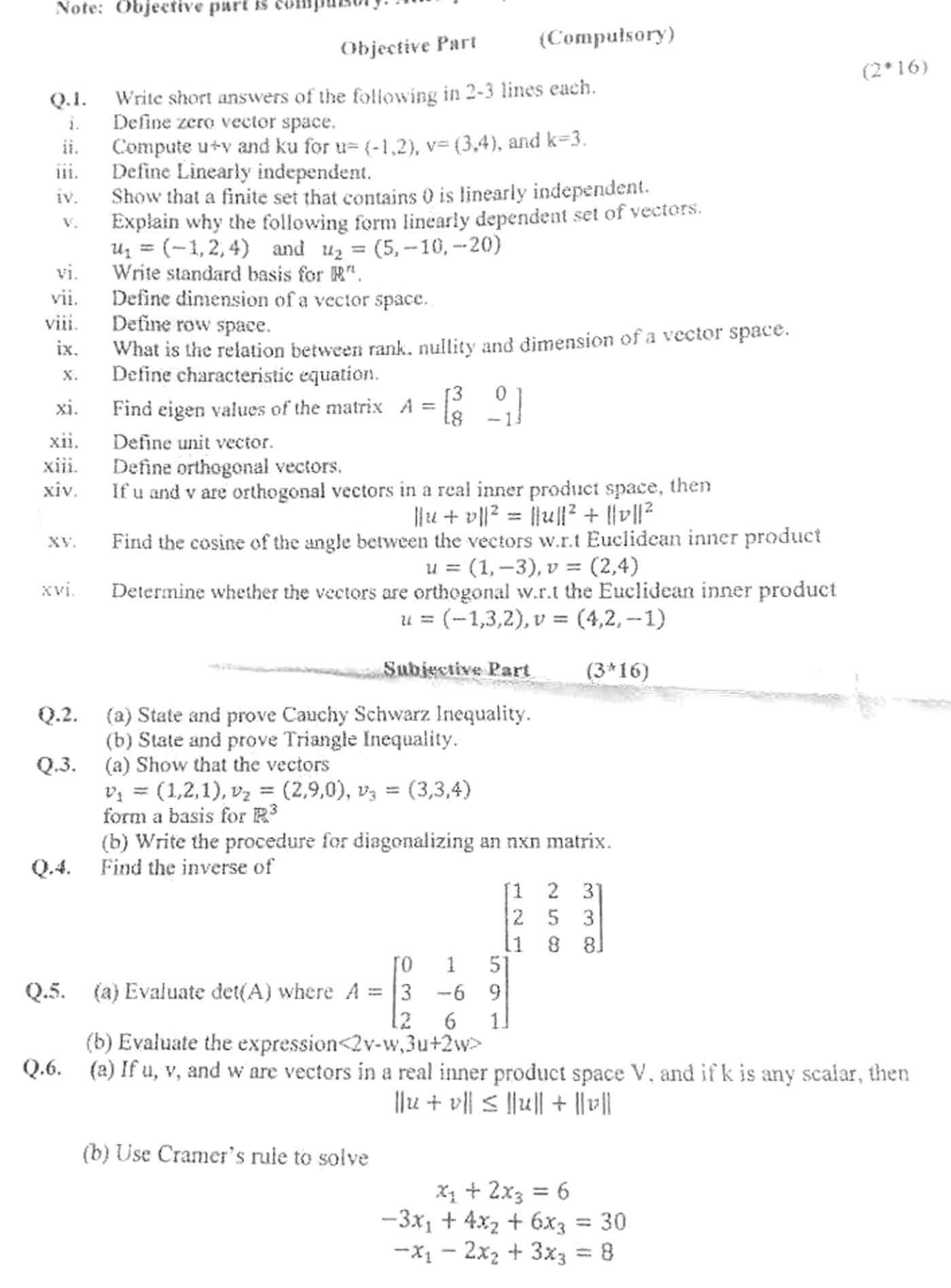
Original paper (scanned copy)
The clean paper above is retyped by Shining Study from this original University of Sargodha question paper. Click the scan to view it full size.
Solved answers
Q1 – Short questions
(i) Zero vector space: the vector space V = {0} containing only the zero vector, with 0 + 0 = 0 and k0 = 0. Its dimension is 0.
(ii) u + v = (−1 + 3, 2 + 4) = (2, 6); ku = 3(−1, 2) = (−3, 6).
(iii) Linearly independent: vectors v₁, …, vᵣ are linearly independent if k₁v₁ + k₂v₂ + … + kᵣvᵣ = 0 has only the trivial solution k₁ = k₂ = … = kᵣ = 0.
(iv) Note: the statement in the paper should read “linearly dependent”. If S = {v₁, …, vᵣ, 0}, then 0·v₁ + … + 0·vᵣ + 1·0 = 0 is a linear combination equal to zero with a non-zero coefficient (1). So S is linearly dependent.
(v) u₂ = (5, −10, −20) = −5(−1, 2, 4) = −5u₁, so 5u₁ + u₂ = 0 – a non-trivial combination gives zero; one vector is a scalar multiple of the other, so the set is linearly dependent.
(vi) e₁ = (1, 0, …, 0), e₂ = (0, 1, 0, …, 0), …, eₙ = (0, …, 0, 1).
(vii) Dimension: the number of vectors in any basis of the vector space (for example dim ℝⁿ = n; dim {0} = 0).
(viii) Row space: the subspace of ℝⁿ spanned by the row vectors of an m × n matrix A.
(ix) Rank–nullity theorem: for an m × n matrix A, rank(A) + nullity(A) = n (the number of columns). For a linear transformation T: V → W, rank(T) + nullity(T) = dim V.
(x) Characteristic equation: det(λI − A) = 0; its roots are the eigenvalues of the square matrix A.
(xi) det(λI − A) = (λ − 3)(λ + 1) − 0 = 0 (A is lower-triangular), so the eigenvalues are λ = 3 and λ = −1.
(xii) Unit vector: a vector of norm (length) 1, ‖u‖ = 1. Any non-zero v can be normalized: u = v/‖v‖.
(xiii) Orthogonal vectors: u and v are orthogonal if their inner product is zero, ⟨u, v⟩ = 0.
(xiv) Proof (generalized Pythagoras): ‖u + v‖² = ⟨u + v, u + v⟩ = ‖u‖² + 2⟨u, v⟩ + ‖v‖² = ‖u‖² + ‖v‖², since ⟨u, v⟩ = 0. ∎
(xv) u·v = (1)(2) + (−3)(4) = −10; ‖u‖ = √10, ‖v‖ = √20. cos θ = −10/√200 = −10/(10√2) = −1/√2 ≈ −0.7071 (θ = 135°).
(xvi) u·v = (−1)(4) + (3)(2) + (2)(−1) = −4 + 6 − 2 = 0, so u and v are orthogonal.
Q2
(a) Cauchy–Schwarz inequality: if u and v are vectors in a real inner product space, then |⟨u, v⟩| ≤ ‖u‖ ‖v‖.
Proof. If u = 0, both sides are 0 and the result holds. Let u ≠ 0. For every real t, ⟨tu + v, tu + v⟩ ≥ 0 (positivity axiom). Expanding:
0 ≤ ⟨tu + v, tu + v⟩ = ⟨u,u⟩t² + 2⟨u,v⟩t + ⟨v,v⟩ = at² + bt + c
where a = ⟨u,u⟩ > 0, b = 2⟨u,v⟩, c = ⟨v,v⟩.
A quadratic at² + bt + c with a > 0 that is never negative has at most one real root, so its discriminant is ≤ 0: b² − 4ac ≤ 0 ⇒ 4⟨u, v⟩² − 4⟨u, u⟩⟨v, v⟩ ≤ 0 ⇒ ⟨u, v⟩² ≤ ‖u‖²‖v‖². Taking square roots: |⟨u, v⟩| ≤ ‖u‖ ‖v‖. ∎
(b) Triangle inequality: for vectors u, v in a real inner product space, ‖u + v‖ ≤ ‖u‖ + ‖v‖.
Proof.
‖u + v‖² = ⟨u + v, u + v⟩
         = ⟨u,u⟩ + 2⟨u,v⟩ + ⟨v,v⟩
         ≤ ‖u‖² + 2|⟨u,v⟩| + ‖v‖²        (a ≤ |a|)
         ≤ ‖u‖² + 2‖u‖‖v‖ + ‖v‖²         (Cauchy–Schwarz)
         = (‖u‖ + ‖v‖)²
Both sides are non-negative, so taking square roots gives ‖u + v‖ ≤ ‖u‖ + ‖v‖. ∎ (Q6(a) asks for the same proof.)
Q3
(a) Three vectors in ℝ³ form a basis if they are linearly independent (then they also span ℝ³). Form the matrix with the vectors as columns and find its determinant:
| 1  2  3 |
det | 2  9  3 | = 1(9·4 − 3·0) − 2(2·4 − 3·1) + 3(2·0 − 9·1)
    | 1  0  4 |
               = 36 − 10 − 27 = −1 ≠ 0
Since the determinant is non-zero, the system c₁v₁ + c₂v₂ + c₃v₃ = 0 has only the trivial solution and c₁v₁ + c₂v₂ + c₃v₃ = b is solvable for every b. So {v₁, v₂, v₃} is linearly independent and spans ℝ³ – it is a basis for ℝ³.
(b) Procedure for diagonalizing an n × n matrix A:
- Find the eigenvalues by solving the characteristic equation det(λI − A) = 0.
- For each eigenvalue λ, solve (λI − A)x = 0 to find a basis of its eigenspace.
- If the total number of linearly independent eigenvectors is less than n, A is not diagonalizable. Otherwise take n linearly independent eigenvectors p₁, …, pₙ.
- Form P = [p₁ p₂ … pₙ] (eigenvectors as columns).
- Then P⁻¹AP = D, where D is the diagonal matrix with λ₁, …, λₙ on the diagonal, in the same order as the columns of P.
Q4 – Inverse of the matrix
Let A = [[1, 2, 3], [2, 5, 3], [1, 8, 8]]. det(A) = 1(5·8 − 3·8) − 2(2·8 − 3·1) + 3(2·8 − 5·1) = 16 − 26 + 33 = 23 ≠ 0, so A is invertible.
Cofactors: C₁₁ = 16, C₁₂ = −13, C₁₃ = 11; C₂₁ = 8, C₂₂ = 5, C₂₃ = −6; C₃₁ = −9, C₃₂ = 3, C₃₃ = 1. The adjoint is the transpose of the cofactor matrix:
1   | 16   8  -9 |
A⁻¹ = adj(A)/det(A) = ── | -13  5   3 |
              23  | 11  -6   1 |
Check: first row of A times first column of adj(A): 1(16) + 2(−13) + 3(11) = 23 ✓. (By row reduction [A | I] → [I | A⁻¹] gives the same result.)
Q5
(a) Expanding along the first row:
det(A) = 0·| -6 9 | − 1·| 3 9 | + 5·| 3 -6 |
           |  6 1 |     | 2 1 |     | 2  6 |
       = 0 − 1(3 − 18) + 5(18 + 12)
       = 15 + 150 = 165
det(A) = 165.
(b) Using linearity and symmetry of the inner product:
⟨2v − w, 3u + 2w⟩ = 6⟨v,u⟩ + 4⟨v,w⟩ − 3⟨w,u⟩ − 2⟨w,w⟩
                  = 6⟨u,v⟩ + 4⟨v,w⟩ − 3⟨u,w⟩ − 2‖w‖²
The paper does not print the given values. This question is from Anton’s textbook, where ⟨u, v⟩ = 2, ⟨v, w⟩ = −6, ⟨u, w⟩ = −3, ‖u‖ = 1, ‖v‖ = 2, ‖w‖ = 7. With these: 6(2) + 4(−6) − 3(−3) − 2(49) = 12 − 24 + 9 − 98 = −101. If your teacher gave different values, substitute them into the expanded form.
Q6
(a) This is the triangle inequality – see the proof in Q2(b).
(b) Cramer’s rule
|  1   0  2 |
D = | -3   4  6 | = 1(12 + 12) − 0 + 2(6 + 4) = 24 + 20 = 44
    | -1  -2  3 |

     |  6   0  2 |
D1 = | 30   4  6 | = 6(12 + 12) − 0 + 2(−60 − 32) = 144 − 184 = −40
     |  8  -2  3 |

     |  1   6  2 |
D2 = | -3  30  6 | = 1(90 − 48) − 6(−9 + 6) + 2(−24 + 30) = 42 + 18 + 12 = 72
     | -1   8  3 |

     |  1   0   6 |
D3 = | -3   4  30 | = 1(32 + 60) − 0 + 6(6 + 4) = 92 + 60 = 152
     | -1  -2   8 |
x₁ = D₁/D = −40/44 = −10/11, x₂ = D₂/D = 72/44 = 18/11, x₃ = D₃/D = 152/44 = 38/11.
Check (first equation): −10/11 + 2(38/11) = 66/11 = 6 ✓.
Answers prepared by Shining Study for revision. Check them against your class notes and teacher’s guidance.