
Blog
Game Development Past Paper 2019 – BS IT 8th Term UOS
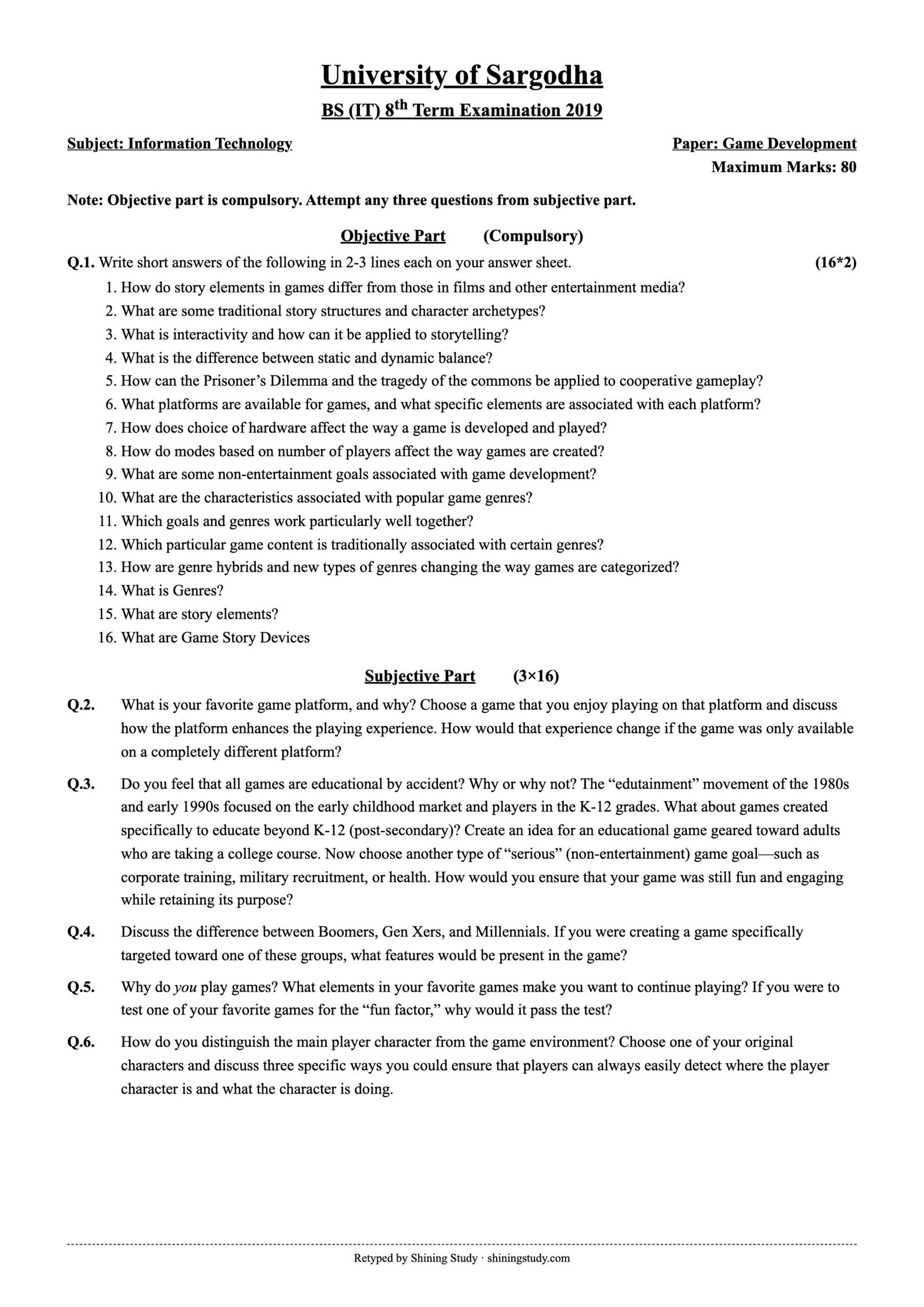
University of Sargodha (UOS) BS IT 8th term Game Development past paper 2019, with the full question paper in text form and solved answers for all short questions and model answers for the long questions.
Print / download (A4, high quality): Full-size paper
Game Development Past Paper 2019 (text version)
University of Sargodha – BS (IT) 8th Term Examination 2019, Subject: Information Technology
Paper: Game Development · Time: not visible in our copy · Maximum marks: 80
Note: Objective part is compulsory. Attempt any three questions from subjective part.
The top of the original photo (course code and time) is cut off; the term and year are from the source of the paper.
Objective part – Q1: Write short answers of the following in 2-3 lines each on your answer sheet. (16*2)
- How do story elements in games differ from those in films and other entertainment media?
- What are some traditional story structures and character archetypes?
- What is interactivity and how can it be applied to storytelling?
- What is the difference between static and dynamic balance?
- How can the Prisoner’s Dilemma and the tragedy of the commons be applied to cooperative gameplay?
- What platforms are available for games, and what specific elements are associated with each platform?
- How does choice of hardware affect the way a game is developed and played?
- How do modes based on number of players affect the way games are created?
- What are some non-entertainment goals associated with game development?
- What are the characteristics associated with popular game genres?
- Which goals and genres work particularly well together?
- Which particular game content is traditionally associated with certain genres?
- How are genre hybrids and new types of genres changing the way games are categorized?
- What is Genres?
- What are story elements?
- What are Game Story Devices
Subjective part (3×16)
Q2. What is your favorite game platform, and why? Choose a game that you enjoy playing on that platform and discuss how the platform enhances the playing experience. How would that experience change if the game was only available on a completely different platform?
Q3. Do you feel that all games are educational by accident? Why or why not? The “edutainment” movement of the 1980s and early 1990s focused on the early childhood market and players in the K-12 grades. What about games created specifically to educate beyond K-12 (post-secondary)? Create an idea for an educational game geared toward adults who are taking a college course. Now choose another type of “serious” (non-entertainment) game goal—such as corporate training, military recruitment, or health. How would you ensure that your game was still fun and engaging while retaining its purpose?
Q4. Discuss the difference between Boomers, Gen Xers, and Millennials. If you were creating a game specifically targeted toward one of these groups, what features would be present in the game?
Q5. Why do you play games? What elements in your favorite games make you want to continue playing? If you were to test one of your favorite games for the “fun factor,” why would it pass the test?
Q6. How do you distinguish the main player character from the game environment? Choose one of your original characters and discuss three specific ways you could ensure that players can always easily detect where the player character is and what the character is doing.
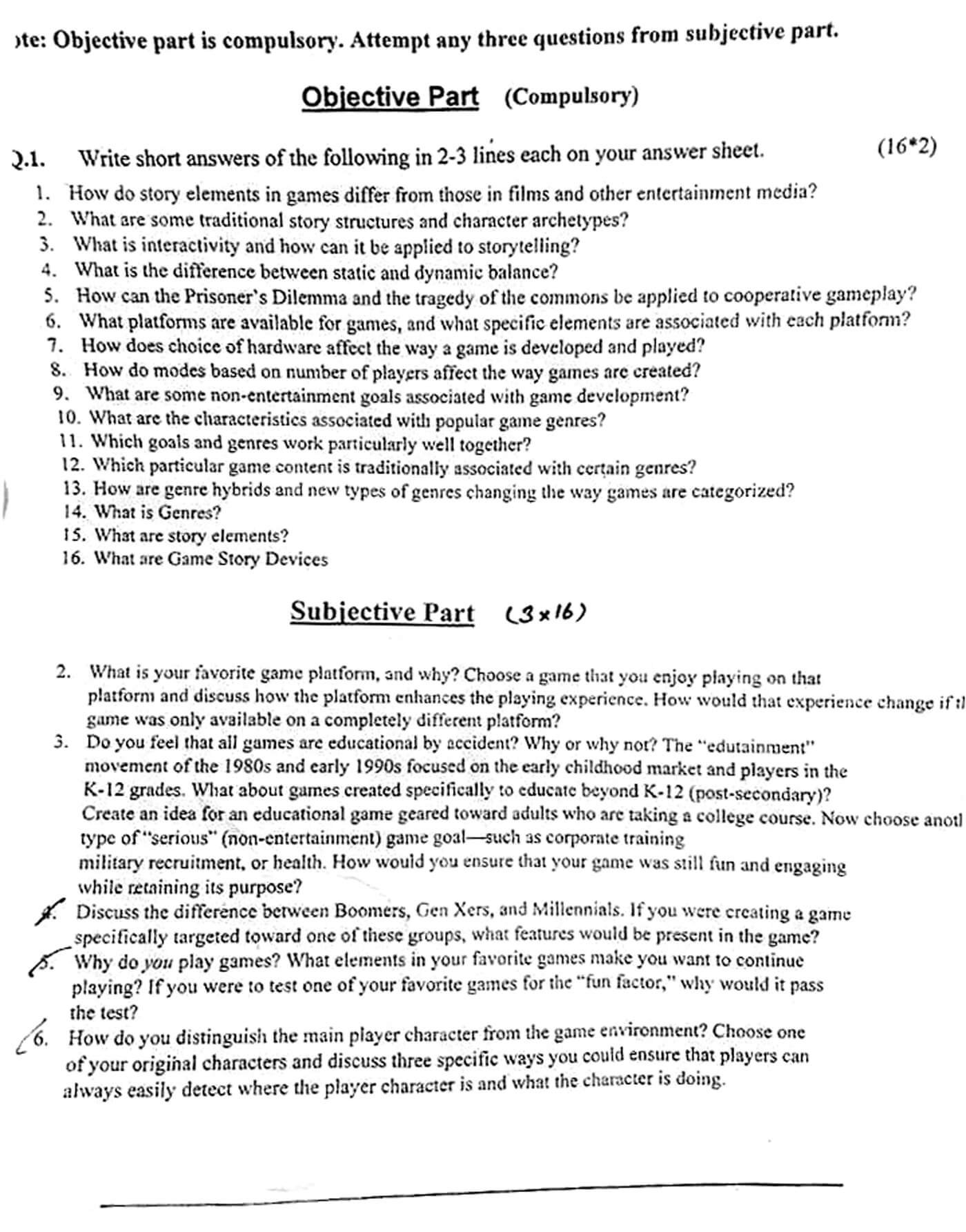
Original paper (scanned copy)
The clean paper above is retyped by Shining Study from this original University of Sargodha question paper. Click the scan to view it full size.
Solved answers
Q1 – Short questions
1. In films and books the audience watches a fixed, linear story. In games the player acts inside the story: the player controls the protagonist, makes choices, can fail and retry, and the story may branch or emerge from gameplay. Pacing is controlled partly by the player, and story must fit around gameplay goals and challenges.
2. Structures: the three-act structure (setup, confrontation, resolution) and the hero’s journey (Campbell) – call to adventure, mentor, trials, ordeal, reward, return. Archetypes: hero, mentor, ally, trickster, shadow/villain, herald, threshold guardian, shapeshifter.
3. Interactivity is the player’s ability to affect the game through input and receive meaningful responses. In storytelling it is applied through dialogue choices, branching paths and multiple endings, player-driven exploration, environmental storytelling, and consequences that change characters and the world.
4. Static balance is fixed at design time – the rules, stats and costs are set so no strategy or unit is dominant (e.g. rock-paper-scissors). Dynamic balance changes during play to keep the game fair and challenging – dynamic difficulty adjustment, rubber-banding in racing games, catch-up mechanics.
5. The Prisoner’s Dilemma shows that players acting for self-interest may both lose, while cooperating gives a better shared outcome; designers use it to reward trust and punish betrayal between players. The tragedy of the commons occurs when players overuse a shared resource until it is gone; cooperative games use shared resources, team goals and rewards for restraint so players must coordinate.
6. Platforms: PC (keyboard/mouse, high graphics, modding, digital stores), consoles (gamepad, TV, standardized hardware), mobile/tablet (touch, short sessions, free-to-play, sensors), handheld consoles (portability), arcade (short intense play), web/browser, and VR/AR (immersion, motion controls) and cloud gaming.
7. Hardware sets the limits on graphics, memory, processing and storage, the input devices (touch, gamepad, motion), screen size and audio, and online capability. Developers must design controls, interface, art quality, session length and performance targets for that hardware, and porting may require major changes.
8. Single-player games focus on story, AI opponents and pacing for one person; two-player and local multiplayer need split screens or shared screens and balanced competition; multiplayer online and MMO games need networking, servers, matchmaking, social features, persistent worlds and anti-cheating, and balance for many simultaneous players.
9. Education (serious/educational games), training and simulation (military, pilots, corporate), health and fitness (exergames, therapy), advertising and marketing (advergames), social change and awareness, research, and recruitment.
10. Action – fast reflexes, hand–eye coordination; adventure – story, exploration and puzzles; role-playing – character development, stats, quests; simulation – realistic systems; strategy – planning and resource management; sports and racing – real-world competition; puzzle – logic; shooters, fighting, horror and casual games each have their own core challenges.
11. Examples: education with puzzle or simulation games; training with simulation; exploration/storytelling with adventure and RPG; competition with sports, fighting and strategy; fitness with rhythm and motion games; social goals with casual and party games.
12. RPGs – quests, levels, inventories, character classes; shooters – weapons, ammo, health packs; strategy – units, resources, tech trees, maps; racing – vehicles, tracks, upgrades; sports – teams, leagues, stats; horror – dark settings, limited resources; puzzle – levels with increasing difficulty.
13. Many modern games mix genres (action-RPG, survival-crafting, battle royale, roguelite, open-world adventure), so strict categories no longer fit. New labels and tags appear, stores classify games by several tags and mechanics, and players choose by experience and features rather than one genre name.
14. Genre: a category of games that share similar gameplay mechanics and challenges (not setting or story), e.g. action, adventure, RPG, strategy, simulation, puzzle, sports.
15. Story elements: premise, backstory, plot, characters (protagonist, antagonist, supporting), setting/world, conflict, theme, goals and obstacles, climax and resolution.
16. Game story devices: techniques used to deliver the story: cut-scenes/cinematics, dialogue and voice-over, in-game text, notes and audio logs, environmental storytelling, flashbacks, quests and missions, branching choices, scripted events and non-player characters.
Q2 – Favourite platform (model answer)
Platform: smartphone (Android/iOS). Game: PUBG Mobile. I prefer mobile because it is always with me, I can play short sessions anywhere, and most of my friends play on phones so it is easy to team up.
How the platform enhances the experience: touch controls with customizable button layouts and gyroscope aiming make shooting feel natural; voice chat through the phone’s microphone allows quick squad coordination; matches are designed for mobile hardware with adjustable graphics, so the game runs on many phones; notifications and daily rewards fit mobile habits; and free-to-play access lets everyone join.
If it were only on a different platform (e.g. PC or console): controls would change to mouse/keyboard or gamepad, giving more precise aiming and a bigger screen with better graphics, but sessions would be tied to a desk or TV; fewer of my friends could join because they don’t own a gaming PC or console; the game might cost money; and the casual “play anywhere” social experience would be lost, while competitive and graphical depth would increase.
Q3 – Are all games educational by accident? Serious game design
Yes, to a large degree. Every game teaches its own rules and requires learning: players practise problem solving, strategic thinking, reading, resource management, hand–eye coordination, teamwork and persistence. Games like SimCity teach systems thinking, Civilization history, and Minecraft creativity and basic logic – even though they were made for fun. However, what is learned is not always intentional or relevant to formal education, so purposely designed educational games are still needed.
Beyond K-12: adult learners also benefit from game-based learning; university and professional training use simulations, case-based role-play and gamified platforms because they give practice in a safe environment and immediate feedback.
Educational game idea for a college course – “Packet Quest” (Computer Networks): the player is a network engineer who must route packets across a growing city network. Levels introduce IP addressing, subnetting, routing tables and protocols; players configure routers, fix broken links and stop attacks under time limits. Points and badges reward efficient designs; leaderboards and co-op missions let classmates compete. Each level maps to a lecture topic, and in-game logs explain why a configuration worked.
Another serious goal – health (“FitQuest”): a mobile adventure where real steps and exercise power the hero’s journey; walking unlocks map areas, workouts defeat bosses, and healthy habits give rewards.
Keeping it fun while keeping the purpose: make the learning part of the core mechanic rather than quizzes added on top; give clear goals, meaningful choices and immediate feedback; use increasing challenge (flow), story and characters, rewards, progression and social competition/cooperation; keep sessions short; test with real users for both learning outcomes and enjoyment; and avoid preaching – let players discover through play.
Q4 – Boomers, Gen X and Millennials
| Generation | Born (approx.) | Gaming background and preferences |
|---|---|---|
| Baby Boomers | 1946–1964 | Grew up before video games; prefer simple, familiar, low-pressure games – card games, puzzles, word games, casual and brain-training games; value clear instructions, larger text, relaxation and social connection with family. |
| Generation X | 1965–1980 | Grew up with arcades and early consoles (Atari, NES); nostalgic for classics; have less free time due to work and family; like strategy, sports, shooters and story games that can be played in shorter sessions; comfortable with technology. |
| Millennials (Gen Y) | 1981–1996 | Grew up with consoles, PCs and the Internet; digital natives; enjoy online multiplayer, social and mobile games, open worlds, achievements and customization; expect frequent updates, sharing and streaming, and fast feedback. |
Game for Baby Boomers – example features: a relaxing garden-building/puzzle game with large readable text and buttons, simple one-touch controls, no time pressure, adjustable difficulty, step-by-step tutorials, the option to pause anytime, brain-training puzzles, family-friendly content, and features to play or share progress with grandchildren. (For Millennials, instead: online co-op, customization, achievements, social sharing and regular new content.)
Q5 – Why I play games and the “fun factor” (model answer)
Why I play: to relax and relieve stress, to enjoy challenge and the feeling of achievement, to experience stories and worlds I cannot visit in real life, and to spend time with friends online.
Elements that keep me playing: clear goals with rewarding progression (levels, unlocks, upgrades); challenges that grow with my skill; interesting story and characters; meaningful choices; competition and cooperation with friends; variety and regular new content; good feedback – sound, visual effects and responsive controls.
Fun-factor test (e.g. for FIFA/EA Sports FC): it passes because it is easy to learn but hard to master; each match is different and unpredictable; skill improvement is visible; it creates exciting moments (late goals) and emotional highs; it supports social play – local matches and online seasons; short matches fit any schedule; and modes like career or Ultimate Team give long-term goals. These match common fun criteria: challenge, mastery, social interaction, fantasy, and a sense of progress.
Q6 – Making the player character stand out
The player must always know where their character is and what it is doing; otherwise they feel lost and frustrated. Example character: “Zara”, a young explorer in a jungle adventure game.
- Visual contrast and silhouette: give Zara a bright red jacket and scarf against the green-brown jungle, a distinctive silhouette (backpack, hat) and slightly higher saturation and lighting than the background; add an outline or glow when she is behind foliage.
- Camera and screen position: keep a third-person camera that follows Zara and keeps her near the centre; the camera zooms out in large areas and avoids obstacles blocking the view; a small marker or arrow appears when she is off-screen or hidden.
- Clear animation and feedback: unique, readable animations for each action (running, climbing, attacking, injured), with sound effects and particle effects (dust, splashes); a health/status indicator near her or on the HUD, and on-screen icons for her current action or state (crouching, poisoned).
Other methods: different colour palettes for player vs enemies, a mini-map with her position, controller vibration, and distinctive footstep or voice sounds.
Answers prepared by Shining Study for revision. Check them against your class notes and teacher’s guidance.