
Blog
Computer Communication & Network (CCN) Past Paper 2015 – MSc IT 2nd Term UOS
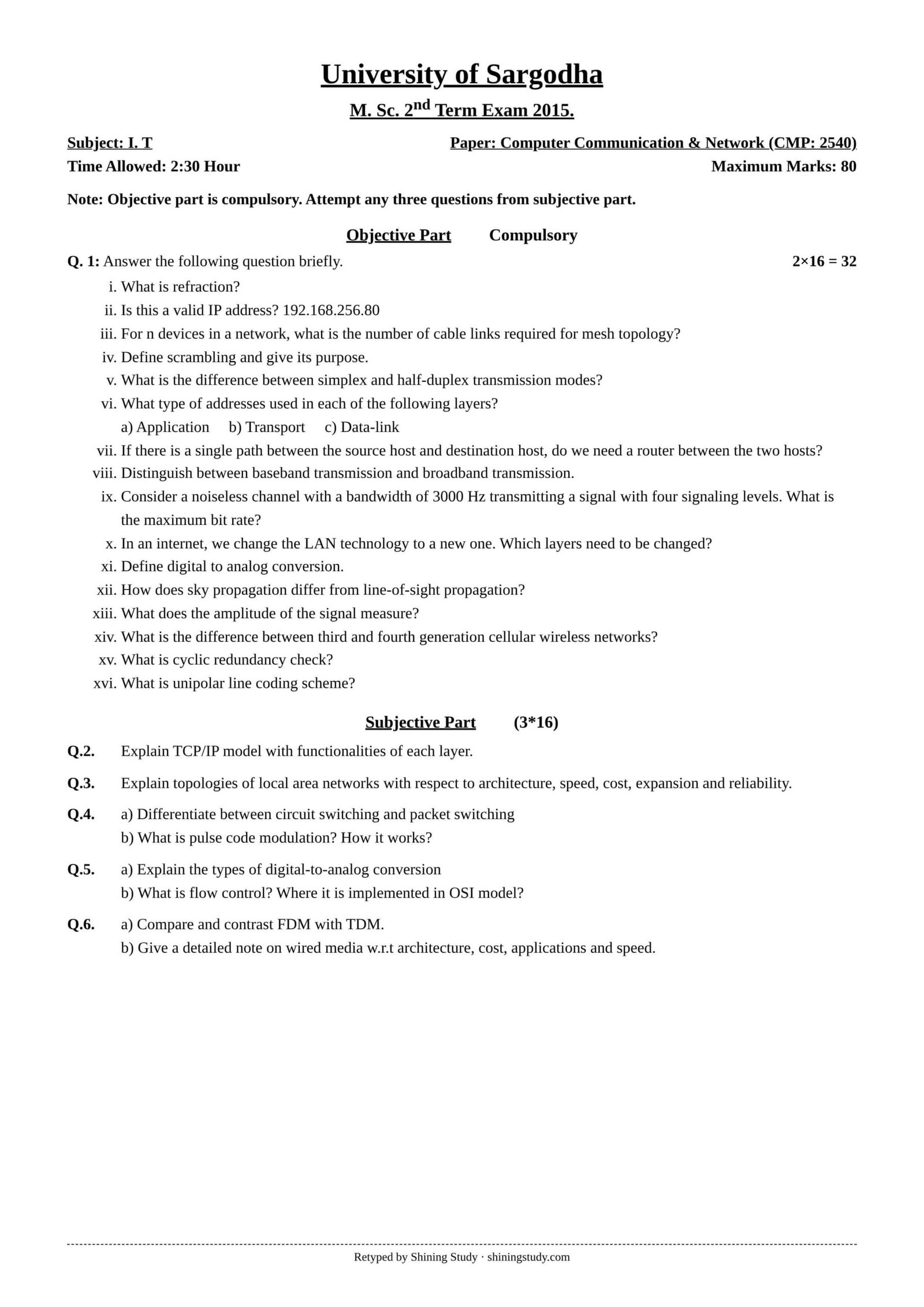
University of Sargodha (UOS) M.Sc. IT 2nd term Computer Communication & Network (CMP-2540) past paper 2015, with the full question paper in text form and solved answers for all short and long questions.
Print / download (A4, high quality): Full-size paper
CCN Past Paper 2015 MSc IT (text version)
University of Sargodha – M.Sc. 2nd Term Exam 2015, Subject: I.T
Paper: Computer Communication & Network (CMP-2540) · Time: 2:30 hours · Maximum marks: 80
Note: Objective part is compulsory. Attempt any three questions from the subjective part.
Objective part (compulsory) – Q1: Answer the following questions briefly (2 × 16 = 32)
- What is refraction?
- Is this a valid IP address? 192.168.256.80
- For n devices in a network, what is the number of cable links required for a mesh topology?
- Define scrambling and give its purpose.
- What is the difference between simplex and half-duplex transmission modes?
- What type of addresses are used in each of the following layers? (a) Application (b) Transport (c) Data-link
- If there is a single path between the source host and destination host, do we need a router between the two hosts?
- Distinguish between baseband transmission and broadband transmission.
- Consider a noiseless channel with a bandwidth of 3000 Hz transmitting a signal with four signaling levels. What is the maximum bit rate?
- In an internet, we change the LAN technology to a new one. Which layers need to be changed?
- Define digital-to-analog conversion.
- How does sky propagation differ from line-of-sight propagation?
- What does the amplitude of a signal measure?
- What is the difference between third and fourth generation cellular wireless networks?
- What is cyclic redundancy check?
- What is the unipolar line coding scheme?
Subjective part (3 × 16)
Q2. Explain the TCP/IP model with the functionalities of each layer.
Q3. Explain the topologies of local area networks with respect to architecture, speed, cost, expansion and reliability.
Q4. (a) Differentiate between circuit switching and packet switching. (b) What is pulse code modulation? How does it work?
Q5. (a) Explain the types of digital-to-analog conversion. (b) What is flow control? Where is it implemented in the OSI model?
Q6. (a) Compare and contrast FDM with TDM. (b) Give a detailed note on wired media w.r.t. architecture, cost, applications and speed.
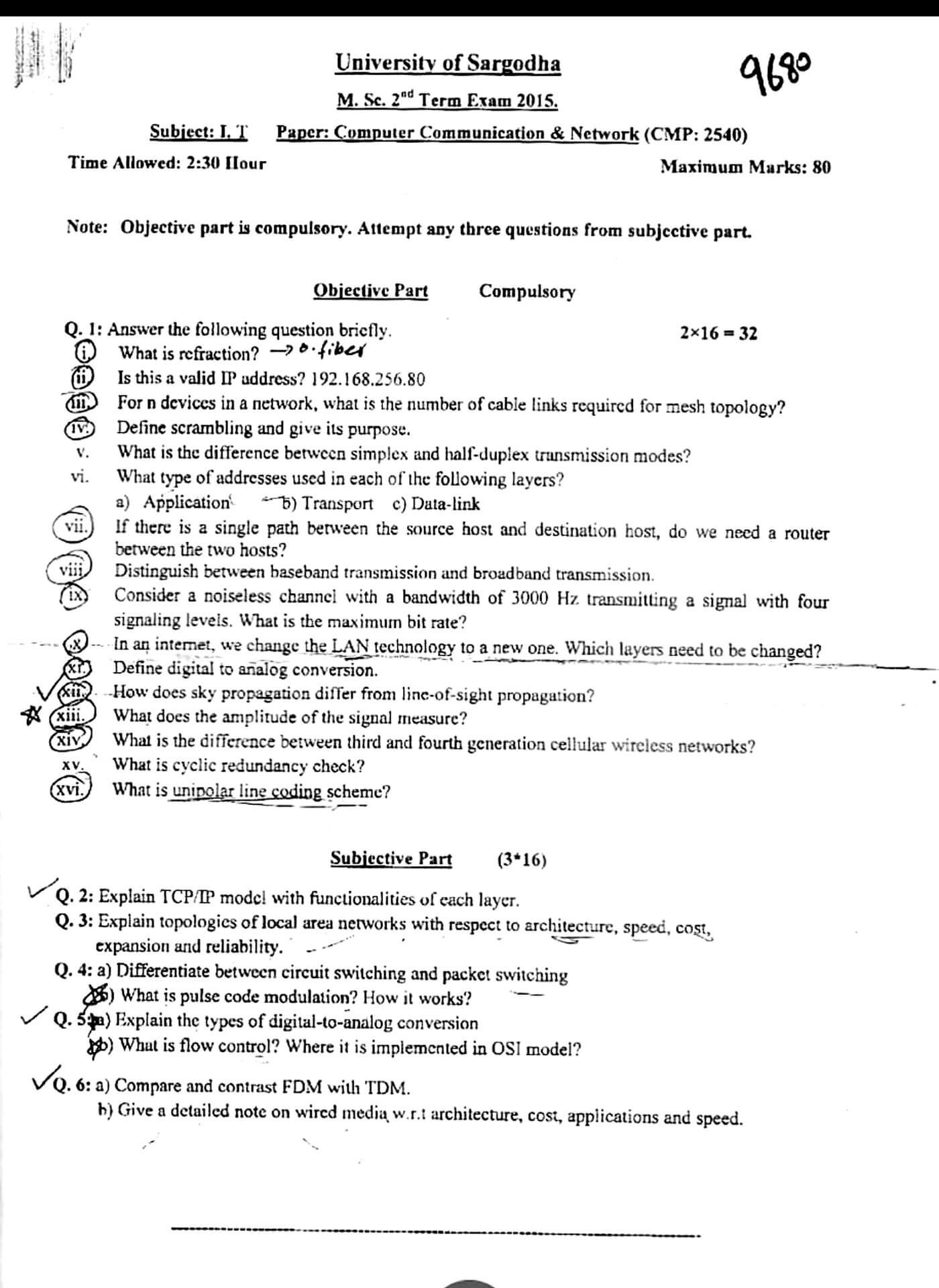
Original paper (scanned copy)
The clean paper above is retyped by Shining Study from this original University of Sargodha question paper. Click a scan to view it full size.
Solved answers
Q1 – Short questions
(i) Refraction: the bending of a wave (e.g. light) when it passes from one medium into another with a different density, because its speed changes. In optical fiber the core/cladding difference makes light reflect back into the core (total internal reflection) when it hits beyond the critical angle.
(ii) No. Each octet of an IPv4 address must be 0–255; the third octet 256 is out of range, so 192.168.256.80 is invalid.
(iii) A full mesh of n devices needs n(n − 1)/2 duplex links (each device has n − 1 ports). Example: 5 devices → 10 links.
(iv) Scrambling: a technique used with bipolar AMI (e.g. B8ZS, HDB3) that replaces long runs of zeros with a special pattern containing violations. Purpose: keep enough transitions for synchronization without increasing bandwidth; the receiver restores the zeros.
(v) Simplex: data flows in one direction only (keyboard → computer, TV broadcast). Half-duplex: both directions, but only one at a time (walkie-talkie).
(vi) (a) Application layer: specific/user-friendly addresses such as email addresses and URLs. (b) Transport layer: port numbers. (c) Data-link layer: physical (MAC) addresses.
(vii) No. Routers are needed to choose among paths and to join different networks. If the two hosts are on a single path within one network, a link-layer device (switch) is enough; a router is needed only if the path crosses different networks.
(viii) Baseband sends the digital signal as it is over a low-pass channel that uses the whole bandwidth of the medium (e.g. Ethernet). Broadband modulates the signal onto a carrier and sends it over a band-pass channel, so many channels can share one medium (e.g. cable TV, DSL).
(ix) Nyquist bit rate = 2 × B × log₂L = 2 × 3000 × log₂4 = 2 × 3000 × 2 = 12,000 bps.
(x) Only the physical and data-link layers need to change, because LAN technology is defined in those two layers. The network layer (IP) and the layers above stay the same.
(xi) Digital-to-analog conversion: changing one of the characteristics of an analog carrier (amplitude, frequency or phase) according to digital data, so the data can travel over an analog (band-pass) medium. Types: ASK, FSK, PSK and QAM.
(xii) Sky propagation: higher-frequency radio waves go up to the ionosphere and are reflected back to earth, allowing long distances with low power. Line-of-sight: very high frequency signals travel in a straight line, so the antennas must face each other and be in sight (microwave, satellite links).
(xiii) Amplitude measures the strength (height) of the signal at an instant – the energy it carries – shown in volts, amperes or watts.
(xiv) 3G (e.g. UMTS, CDMA2000) mixes circuit-switched voice with packet data at a few Mbps. 4G (LTE) is all-IP, packet-switched for both voice and data, uses OFDMA and MIMO and gives much higher speeds (up to ~100 Mbps mobile, 1 Gbps stationary) with lower latency.
(xv) CRC: an error-detection method. The sender divides the data (with n zeros appended) by a fixed generator polynomial using modulo-2 division and attaches the remainder as the CRC. The receiver divides the received frame by the same generator; a zero remainder means no error detected.
(xvi) Unipolar coding: a line coding scheme where all signal levels are on one side of the time axis, e.g. bit 1 = positive voltage, bit 0 = zero voltage (unipolar NRZ). It is simple but has a DC component and no self-synchronization, so it is rarely used now.
Q2 – TCP/IP model
TCP/IP is the protocol suite used on the Internet. It is usually described in five layers (the original model merges the first two as the network access layer):
- Physical layer: carries individual bits over the medium; defines cables, connectors, signals, data rate and line coding.
- Data-link layer: moves frames between two directly connected nodes; framing, MAC addressing, error detection (CRC), flow control and media access (Ethernet, Wi-Fi, PPP).
- Network (Internet) layer: host-to-host delivery across many networks; logical (IP) addressing, routing and fragmentation. Protocols: IP, ICMP, IGMP, ARP.
- Transport layer: process-to-process delivery using port numbers. TCP is connection-oriented and reliable (segmentation, sequence numbers, acknowledgements, flow and congestion control). UDP is connectionless and fast. SCTP is also here.
- Application layer: services for users: HTTP (web), SMTP/POP/IMAP (email), FTP (files), DNS (names), Telnet/SSH (remote login), SNMP.
Compared with OSI, TCP/IP has no separate session and presentation layers – their tasks are handled by applications.
Q3 – LAN topologies
| Topology | Architecture | Speed | Cost | Expansion | Reliability |
|---|---|---|---|---|---|
| Bus | All devices tap into one backbone cable with terminators | Falls as devices/traffic increase (collisions) | Lowest – least cable | Easy to add a node, but limited length and taps | Poor – a backbone break stops the whole network; faults hard to find |
| Star | Each device has its own link to a central hub/switch | High with a switch (dedicated bandwidth per port) | Moderate – more cable plus the switch | Very easy – plug into a free port | Good – one link failing affects only that node; but the central device is a single point of failure |
| Ring | Each device connects to two neighbours forming a closed loop; token passing | Predictable, no collisions; one slow node affects all | Moderate | Hard – the ring must be broken to add a node | A single break can stop the ring (dual ring improves it) |
| Mesh | Every device has a dedicated link to every other: n(n−1)/2 links | Highest – dedicated links, no sharing | Highest – many cables and ports | Difficult – each new node needs links to all | Excellent – many alternate paths; fault isolation easy |
| Hybrid/Tree | Combination, e.g. stars connected by a bus/backbone | Depends on parts | Medium–high | Scales well | Good, but backbone failure splits it |
Q4(a) – Circuit switching vs packet switching
| Circuit switching | Packet switching |
|---|---|
| A dedicated path is set up before data transfer (setup, transfer, teardown) | No dedicated path; data is split into packets routed independently (datagram) or on a virtual circuit |
| Resources reserved for the whole call | Resources shared, allocated on demand |
| Fixed bandwidth, constant delay, in-order delivery | Variable delay; packets may arrive out of order and be reordered |
| Wasteful when the line is idle | Efficient use of the link |
| Used in the traditional telephone network | Used in the Internet |
Q4(b) – Pulse code modulation (PCM)
PCM converts an analog signal (such as voice) into digital data in three steps:
- Sampling: the signal is measured at regular intervals. By the Nyquist theorem the sampling rate must be at least twice the highest frequency (voice 4 kHz → 8000 samples/s). The result is a PAM signal.
- Quantization: each sample is rounded to the nearest of L fixed levels (e.g. 256). The rounding difference is quantization error/noise.
- Encoding: each level is converted to an n-bit code, where n = log₂L (256 levels → 8 bits). Bit rate = sampling rate × n = 8000 × 8 = 64 kbps for telephone voice.
The bits are then sent using a line coding scheme. At the receiver, a decoder and a low-pass filter rebuild the analog signal.
Q5(a) – Types of digital-to-analog conversion
- ASK (amplitude shift keying): amplitude of the carrier changes for each bit value; frequency and phase stay fixed. Simple but sensitive to noise. Binary ASK is also called on-off keying.
- FSK (frequency shift keying): a different carrier frequency represents each bit/symbol (f1 for 0, f2 for 1). More noise-resistant but needs more bandwidth.
- PSK (phase shift keying): the phase of the carrier changes (BPSK: 0° and 180°; QPSK: four phases, 2 bits per symbol). Less affected by noise than ASK and more bandwidth-efficient than FSK.
- QAM (quadrature amplitude modulation): changes both amplitude and phase, so each symbol carries many bits (16-QAM = 4 bits). Used in modems, DSL, Wi-Fi.
Q5(b) – Flow control
Flow control is a set of procedures that stops a fast sender from overwhelming a slow receiver. The receiver has limited buffer and processing speed, so the sender must wait for permission (acknowledgements) before sending more. Methods: Stop-and-Wait (send one frame, wait for ACK) and Sliding Window (send several frames up to the window size).
In the OSI model it is implemented at the data-link layer (hop-to-hop, between adjacent nodes) and at the transport layer (end-to-end, e.g. TCP’s sliding window using the receiver’s advertised window).
Q6(a) – FDM vs TDM
| FDM | TDM |
|---|---|
| Frequency-division multiplexing – each signal gets its own frequency band | Time-division multiplexing – each signal gets its own time slot |
| All signals are sent at the same time | Signals take turns; the link carries one slot at a time |
| Analog technique | Digital technique (can carry digitized analog) |
| Needs guard bands between channels | Needs synchronization/framing bits between frames |
| Crosstalk between adjacent bands possible | No crosstalk, but slots are wasted if a source is idle (synchronous TDM); statistical TDM fixes this |
| Examples: radio/TV broadcasting, cable TV, first-generation cellular | Examples: T1/E1 lines, digital telephone networks, GSM |
Similarity: both share one link among many channels to use bandwidth efficiently.
Q6(b) – Wired (guided) media
- Twisted-pair cable: architecture – pairs of insulated copper wires twisted to cancel noise; UTP (unshielded) or STP (with foil shield). Categories Cat5e, Cat6, Cat6a. Cost – cheapest and easiest to install. Speed – 100 Mbps to 10 Gbps up to about 100 m. Applications – telephone lines, DSL, Ethernet LANs.
- Coaxial cable: architecture – central copper conductor, insulator, braided metal shield and outer jacket (RG-59, RG-58, RG-11). Cost – moderate. Speed – higher bandwidth than twisted pair, hundreds of Mbps over longer distances, but signal attenuates and needs repeaters. Applications – cable TV, cable Internet, older 10Base2/10Base5 Ethernet.
- Fiber-optic cable: architecture – glass/plastic core surrounded by cladding of lower density, signals sent as light (by total internal reflection); single-mode or multimode. Cost – highest (cable, installation and optical equipment). Speed – very high bandwidth (Gbps to Tbps) over many kilometers, immune to electromagnetic interference, light weight and secure. Applications – Internet backbones, undersea cables, FTTH, data centers.
Answers prepared by Shining Study for revision. Check them against your class notes and teacher’s guidance.