
Blog
E-Commerce Application Development Past Paper 2018 – BS IT 7th Term UOS
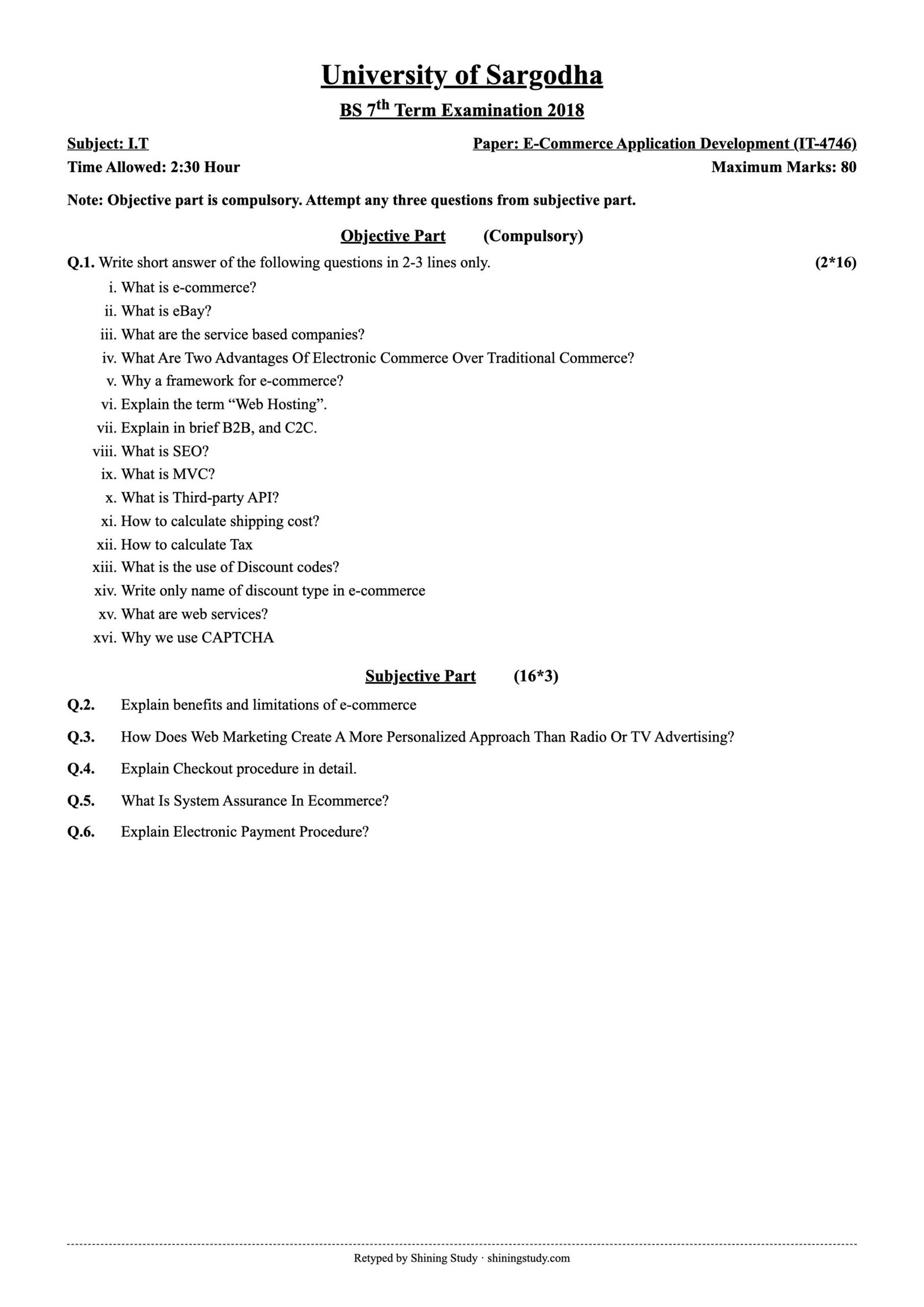
University of Sargodha (UOS) BS IT 7th term E-Commerce Application Development (IT-4746) past paper 2018, with the full question paper in text form and solved answers for all short and long questions.
Print / download (A4, high quality): Full-size paper
E-Commerce Application Development Past Paper 2018 BS IT (text version)
University of Sargodha – BS 7th Term Examination 2018, Subject: I.T
Paper: E-Commerce Application Development (IT-4746) · Time: 2:30 Hour · Maximum marks: 80
Note: Objective part is compulsory. Attempt any three questions from subjective part.
In our copy of the paper the right edge is cut off: the maximum marks (80, from 2×16 + 3×16) and the last word of Q3 (“TV”) are filled in from context.
Objective part – Q1: Write short answer of the following questions in 2-3 lines only. (2*16)
- What is e-commerce?
- What is eBay?
- What are the service based companies?
- What Are Two Advantages Of Electronic Commerce Over Traditional Commerce?
- Why a framework for e-commerce?
- Explain the term “Web Hosting”.
- Explain in brief B2B, and C2C.
- What is SEO?
- What is MVC?
- What is Third-party API?
- How to calculate shipping cost?
- How to calculate Tax
- What is the use of Discount codes?
- Write only name of discount type in e-commerce
- What are web services?
- Why we use CAPTCHA
Subjective part (16*3)
Q2. Explain benefits and limitations of e-commerce
Q3. How Does Web Marketing Create A More Personalized Approach Than Radio Or TV Advertising?
Q4. Explain Checkout procedure in detail.
Q5. What Is System Assurance In Ecommerce?
Q6. Explain Electronic Payment Procedure?
Original paper (scanned copy)
The clean paper above is retyped by Shining Study from this original University of Sargodha question paper. Click the scan to view it full size.
Solved answers
Q1 – Short questions
(i) E-commerce: buying and selling goods and services, and transferring money and data, over the Internet. Examples: online stores, online banking, ticket booking.
(ii) eBay: a global online marketplace (founded 1995) where individuals and businesses sell new and used items through auctions or fixed-price “Buy It Now” listings – a classic C2C and B2C platform.
(iii) Service-based companies: companies that sell services instead of physical products, e.g. software houses, web hosting, banks, airlines, ride-hailing (Careem, Uber), food delivery (Foodpanda), online education.
(iv) Two advantages over traditional commerce: (1) open 24/7 and reaches customers worldwide without a physical shop; (2) lower costs (rent, staff, inventory) and easy comparison of prices, so goods can be cheaper. Others: personalization, fast information.
(v) Why a framework: an e-commerce framework (e.g. Laravel, Magento, WooCommerce) gives ready, tested components – catalog, cart, checkout, users, payment integration, security, MVC structure – so development is faster, more secure, consistent and easier to maintain and scale.
(vi) Web hosting: renting space and resources on an Internet-connected server to store a website’s files and database so it is accessible 24/7 through a domain name (shared, VPS, dedicated, cloud).
(vii) B2B and C2C: B2B (business-to-business) – businesses sell to other businesses, e.g. Alibaba, wholesale suppliers. C2C (consumer-to-consumer) – individuals sell to each other through a platform, e.g. OLX, eBay.
(viii) SEO: Search Engine Optimization – improving a website’s content, structure, speed and links so it ranks higher in organic (unpaid) search results on Google, bringing more visitors.
(ix) MVC: Model–View–Controller design pattern. Model handles data and business logic, View displays the UI, Controller receives user requests, calls the model and chooses the view. It separates concerns and makes code organized and reusable.
(x) Third-party API: an API provided by an outside company that a site integrates instead of building the feature itself – e.g. payment gateways (Stripe, JazzCash), shipping/courier tracking, Google Maps, SMS and social login.
(xi) Shipping cost calculation: by flat rate, by order total (free above a limit), by weight/volume (often volumetric weight = L×W×H/5000), by destination zone/distance, or real-time rates from courier APIs; plus handling and express charges.
(xii) Tax calculation: tax = taxable amount × tax rate, where the taxable amount is the price after discounts (shipping may or may not be included) and the rate depends on the product type and customer location, e.g. 18% GST on Rs. 1000 = Rs. 180. Prices may be shown tax-inclusive or tax-exclusive.
(xiii) Discount codes use: to attract new customers, reward loyal ones, recover abandoned carts, clear stock, run seasonal promotions and track the success of marketing campaigns.
(xiv) Discount types: percentage discount, fixed-amount discount, free shipping, buy-one-get-one (BOGO), bundle discount, tiered/volume discount, first-order discount, seasonal/flash sale, loyalty discount.
(xv) Web services: software components that let applications communicate over the web using standard protocols (HTTP with SOAP/XML or REST/JSON), independent of platform and language – e.g. a store calling a payment or shipping service.
(xvi) CAPTCHA: a challenge (distorted text, image selection, checkbox) that humans can pass but bots cannot. It is used on login, registration, comment and checkout forms to stop spam, fake accounts, brute-force attacks and automated bots.
Q2 – Benefits and limitations of e-commerce
Benefits to organizations: global reach to millions of customers; 24/7 availability; lower operating costs (no physical store, less staff, digital catalogs); lower inventory with drop-shipping/just-in-time; easy to start and scale; detailed customer data and analytics for personalized marketing; faster supply chains (B2B); new business models.
Benefits to customers: shop anytime, anywhere; wider choice and easy price comparison; lower prices and deals; quick delivery of digital products; reviews and ratings help decisions; home delivery and multiple payment options.
Benefits to society: less travel and pollution, jobs in delivery and IT, access to products in rural areas, digital payments and government services.
Technical limitations: security and privacy risks (hacking, card fraud, data leaks); need for reliable Internet, hosting and bandwidth; integration with existing systems and payment gateways is complex; changing software standards; website downtime.
Non-technical limitations: lack of trust (fake sellers, quality differs from pictures); customers cannot touch or try products; delivery delays and high return rates; legal and tax issues across borders; low digital literacy and card usage (heavy COD in Pakistan); high marketing cost and strong competition; less personal interaction.
Q3 – Web marketing vs radio/TV advertising
Radio and TV are broadcast media: the same message is sent to everyone at a fixed time, with little knowledge of who is listening and no direct response. Web marketing is personalized because:
- Targeting: ads can target people by age, location, interests, search keywords and behaviour (Google Ads, Facebook Ads) instead of a mass audience.
- Data and tracking: cookies, accounts and analytics record browsing and purchase history, so the site knows what each visitor likes.
- Personalized content: product recommendations (“customers who bought this…”), personalized home pages, emails with the customer’s name and abandoned-cart reminders.
- Retargeting: visitors who viewed a product later see ads for that same product.
- Two-way interaction: customers can click, comment, chat, review and share; brands reply in real time on social media.
- Measurable and flexible: clicks, conversions and ROI are measured exactly; A/B testing and instant changes of the message are possible, and budgets can be small.
So web marketing speaks to the individual (one-to-one), while radio/TV speak to the crowd (one-to-many).
Q4 – Checkout procedure
- Cart review: customer checks products, quantities and prices; updates the cart and applies discount codes.
- Sign in / guest checkout / register.
- Billing and shipping address: entered or selected from the address book and validated.
- Shipping method: standard/express; the system calculates shipping cost and delivery date.
- Taxes and totals: subtotal − discount + tax + shipping = grand total.
- Payment: select card, wallet, bank transfer or COD; online payments go through a secure gateway (SSL) for authorization.
- Order review and confirmation: customer accepts terms and clicks “Place order”.
- Order processing: the order is stored, stock is updated, the cart is cleared and an order number is generated.
- Notification: confirmation page plus email/SMS with invoice; the order can be tracked until delivery.
Best practices: few steps with a progress bar, guest checkout, clear costs up front, trust badges, mobile-friendly forms and saved details for returning customers.
Q5 – System assurance in e-commerce
System assurance means making sure the e-commerce system is secure, reliable, available and correct, so customers and the business can trust it. It covers:
- Security (confidentiality, integrity, authentication, non-repudiation): SSL/TLS encryption, strong authentication, hashed passwords, firewalls, PCI-DSS compliance for card data, digital signatures and certificates, protection against SQL injection, XSS, CSRF.
- Availability and reliability: good hosting, load balancing, redundancy, monitoring, regular backups and disaster-recovery plans so the store stays online.
- Accuracy and integrity of transactions: correct prices, taxes, stock and payments; database transactions; logging and audit trails.
- Privacy: protecting customer data, clear privacy policies, consent for cookies and marketing.
- Testing and quality assurance: functional, performance, security (penetration) and usability testing before and after changes.
- Third-party assurance: trust seals and audits (e.g. SSL certificate authorities, PCI audits, WebTrust) that show customers the site is safe.
Q6 – Electronic payment procedure
- Customer places order and enters card details (or chooses a wallet) on the merchant’s secure (HTTPS) checkout page.
- Encryption and gateway: details are encrypted and sent to the payment gateway (e.g. Stripe, 1LINK, JazzCash), which acts like a digital card terminal.
- Payment processor and card network: the gateway forwards the request to the acquirer/processor, which routes it through the card network (Visa/MasterCard).
- Issuing bank authorization: the customer’s bank checks the card, balance/limit and fraud rules; it may ask for 3-D Secure OTP. It approves or declines.
- Response: the approval/decline travels back through network → processor → gateway → merchant site, usually in a few seconds. The customer sees confirmation.
- Settlement (clearing): later (usually the same day), the merchant’s batch of approved transactions is sent; the issuing bank transfers the money through the network to the acquiring (merchant’s) bank.
- Funding: the acquiring bank deposits the amount minus fees (MDR) into the merchant’s account.
Parties involved: customer, merchant, payment gateway, acquiring bank, card network, issuing bank. Security: SSL, tokenization, PCI-DSS, 3-D Secure and fraud screening.
Answers prepared by Shining Study for revision. Check them against your class notes and teacher’s guidance.