
Blog
Software Engineering Past Paper 2024 | BS 4th Term UOS (CMPC-204)
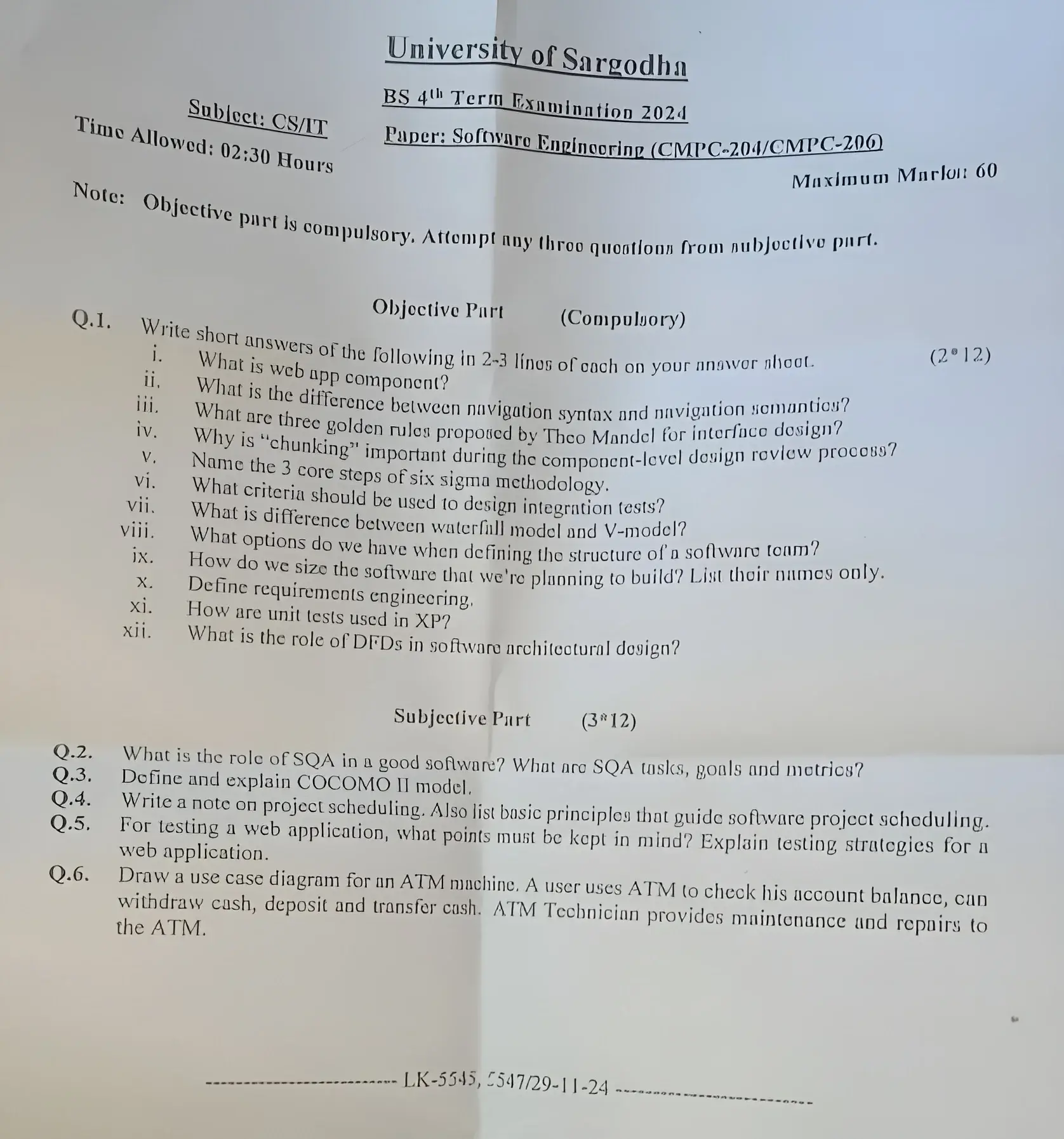
University: University of Sargodha (UOS)
Program: BS 4th Term
Subject: Software Engineering (CMPC-204 / CMPC-260)
Year: 2024
Time Allowed: 2 Hours 30 Minutes
Maximum Marks: 60
Why Use This Software Engineering Past Paper?
This Software Engineering past paper helps students understand real exam patterns, important theory questions, and commonly repeated concepts. It contains objective and subjective questions used in final university examinations.
- Revise core software engineering concepts
- Understand UML, SQA, COCOMO, and development models
- Prepare structured theoretical answers
- Improve exam writing and confidence
Software Engineering Past Paper 2024 (Complete)
University of Sargodha
BS 4th Term Examination 2024Subject: CS/IT
Paper: Software Engineering (CMPC-204/CMPC-260)Note: Objective part is compulsory. Attempt any three questions from subjective part.
Objective Part (Compulsory)
Q.1 Write short answers (2–3 lines each):
- What is a web app component?
- What is the difference between navigation syntax and navigation semantics?
- What are Theo Mandel’s golden rules for interface design?
- Why is chunking important in component review?
- Name three core steps of Six Sigma.
- What criteria should be used to design integration tests?
- Difference between Waterfall and V-Model?
- Options when defining software structure?
- How do we size software to be built?
- Define requirements engineering.
- How are unit tests used in XP?
- Role of DFDs in architectural design?
Subjective Part (Attempt any Three)
Q.2 Role of SQA, goals, tasks, and metrics.
Q.3 Explain COCOMO II cost estimation model.
Q.4 Write a note on project scheduling and principles of software scheduling.
Q.5 Web application testing strategies and key testing points.
Q.6 Draw and explain a use-case diagram for an ATM system.
Software Engineering 2024 – solved answers
Short questions
- Web app component: a well-defined, cohesive function that manipulates content or provides processing for the end user, or a cohesive package of content and functionality (e.g. a shopping-cart module or a login form with its server logic).
- Navigation semantics vs syntax: semantics defines what navigation is needed – the paths and links each user role requires to reach goals (navigation semantic units). Syntax defines how it is implemented – the mechanics such as links, menus, tabs, breadcrumbs and search.
- Theo Mandel’s golden rules: (1) place the user in control, (2) reduce the user’s memory load, (3) make the interface consistent.
- Chunking in component review: reviewers lose attention on large amounts of design; splitting a component into small, focused chunks keeps each review short and thorough, so more defects are found.
- Six Sigma core steps (DMAIC): Define, Measure, Analyze – followed by Improve and Control for an existing process (or Design and Verify for a new one).
- Integration test criteria: interface integrity (data passed correctly between modules), functional validity, information content (global data structures) and performance; test critical modules early, and run regression tests after each integration.
- Waterfall vs V-model: Waterfall is a linear sequence where testing comes after coding. The V-model pairs each development phase with a testing phase (requirements ↔ acceptance test, design ↔ integration test, coding ↔ unit test), so test planning starts early.
- Team structure options: closed paradigm (traditional hierarchy), random paradigm (loose, individual initiative), open paradigm (mix of control and innovation, decisions by consensus) and synchronous paradigm (work divided by natural problem compartments) – or, in older terms, democratic decentralized, controlled decentralized and controlled centralized teams.
- Sizing software: lines of code (LOC), function points, use-case points, object points or story points; estimated through fuzzy-logic sizing, standard component sizing and change sizing, using historical data.
- Requirements engineering: the tasks that produce an understanding of what the system must do: inception, elicitation, elaboration, negotiation, specification, validation and requirements management.
- Unit tests in XP: tests are written before the code (test-first), automated and run every time code is integrated, so they act as a regression suite and give confidence for refactoring.
- Role of DFDs in architectural design: DFDs model how information flows through the system; through transform mapping and transaction mapping they are converted into a call-and-return program structure.
Subjective questions
Q.2 Software Quality Assurance (SQA): SQA is a planned set of activities that ensures the process and product meet defined quality standards. Goals: requirements quality (clear, complete), design quality, code quality, and quality-control effectiveness. Tasks (SQA group): prepare the SQA plan; take part in defining the project’s process; review engineering activities for process compliance; audit work products; ensure deviations are documented and handled; record non-compliance and report to management. Metrics: defect density (defects/KLOC), defect removal efficiency DRE = E/(E + D), mean time to failure, review coverage, requirements volatility, and customer-reported defects.
Q.3 COCOMO II: a hierarchy of three models. (1) Application composition – for early prototyping; size in object points (screens, reports, 3GL components weighted by complexity); NOP = object points × (100 − %reuse)/100; effort = NOP / productivity rate. (2) Early design – after requirements, using function points. (3) Post-architecture – during construction, using KLOC or FP. Effort: PM = A × SizeE × ΠEM, with A ≈ 2.94, E = 0.91 + 0.01 × ΣSF. The five scale factors are precedentedness, development flexibility, architecture/risk resolution, team cohesion and process maturity; the effort multipliers (17 in post-architecture) cover product, platform, personnel and project attributes. Schedule: TDEV = 3.67 × PMF, F = 0.28 + 0.2 × (E − 0.91).
Q.4 Project scheduling: distributing estimated effort across the planned duration by assigning tasks to people and time. Principles: compartmentalization (break the project into tasks), interdependency (find which tasks depend on others), time allocation (start and end date for each task), effort validation (never assign more people than available), defined responsibilities, defined outcomes (a work product per task) and defined milestones. Tools: work breakdown structure, task network, PERT/CPM to find the critical path, Gantt/timeline charts, and earned-value analysis to track progress. Effort is often split by the 40-20-40 rule (analysis/design, coding, testing).
Q.5 Web application testing strategies: content testing (errors in text, graphics, data), interface testing (forms, links, scripts), navigation testing (every path and link works), component testing (each function and module), configuration testing (browsers, OS, devices, servers), security testing (authentication, injection, encryption), performance testing (load and stress), usability and compatibility testing. Key points: test from the user’s view, start with content and interface, test on real devices and networks, automate regression, and test under peak load before launch.
Q.6 Use-case diagram – ATM system:
Actors: Customer (primary), Bank System (secondary), Technician

             +-------------------- ATM System --------------------+
 Customer ---|--( Insert Card )                                    |
         ----|--( Withdraw Cash ) ---<<include>>--> ( Authenticate / Enter PIN )
         ----|--( Deposit Funds ) ---<<include>>--> ( Authenticate / Enter PIN )
         ----|--( Transfer Funds ) --<<include>>--> ( Authenticate / Enter PIN )
         ----|--( Check Balance ) ---<<include>>--> ( Authenticate / Enter PIN )
             |   ( Print Receipt ) ---<<extend>>---> ( Withdraw Cash )
             |   ( Invalid PIN / Retain Card ) --<<extend>>--> ( Authenticate )
 Technician -|--( Refill Cash ) , ( Perform Maintenance )          |
             +----------------------------------------------------+---- Bank System
Explanation: the Customer is the primary actor. Withdraw, Deposit, Transfer and Check Balance each include Authenticate, because a valid card and PIN are always required. Print Receipt extends Withdraw (optional), and Invalid PIN/Retain Card extends Authenticate (only on failure). The Bank System verifies accounts and updates balances, and the Technician refills cash and maintains the machine.
Answers prepared by Shining Study for revision. Check them against your class notes and teacher’s guidance.
Download
Download Software Engineering Past Paper 2024 (PDF)
Exam Tips
- Relate theory with real-world examples
- Draw clear diagrams in use-case and DFD questions
- Explain models with advantages and limitations
- Practice time-bound writing
Related Past Papers
Parent Category: Past Papers