
Blog
10 steps Statement of Purpose (SOP): An easy and Complete Guide
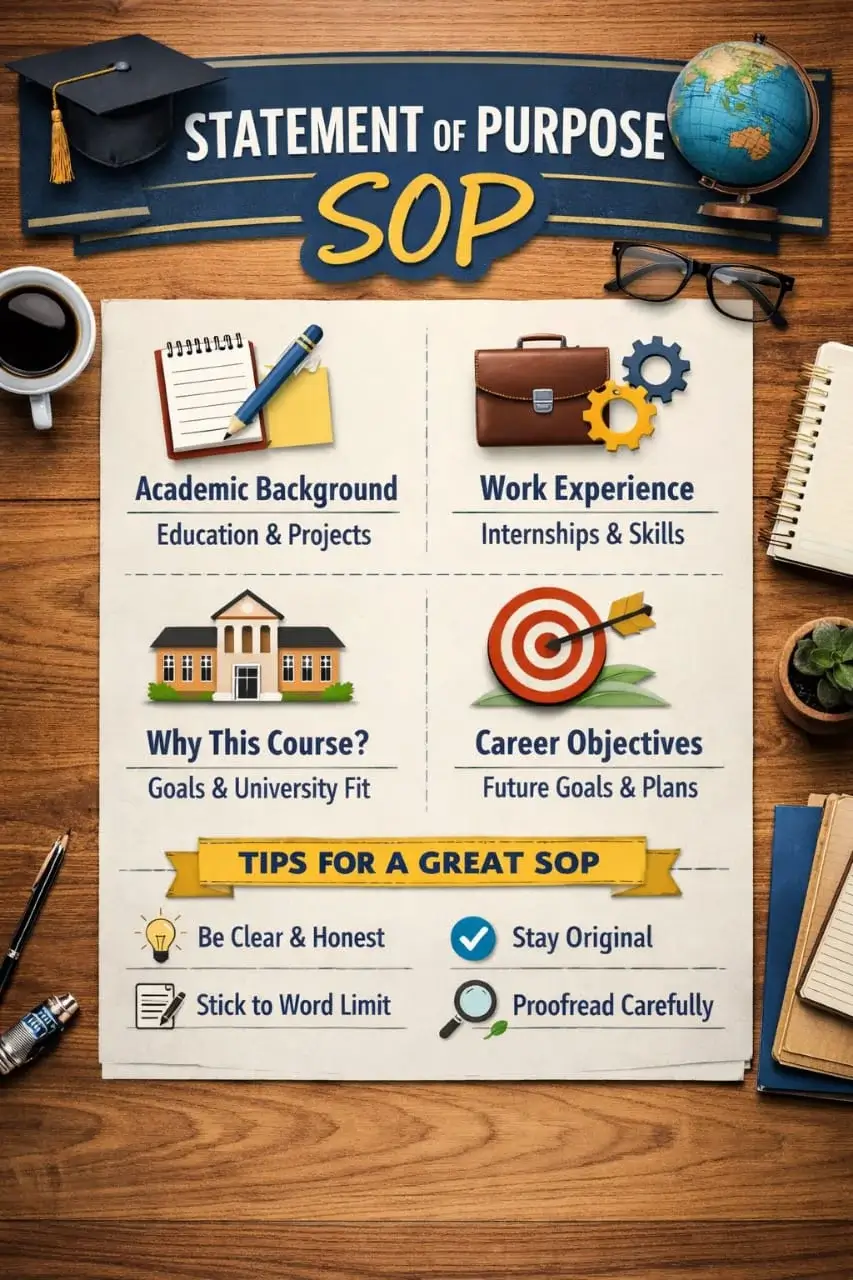
A Statement of Purpose (SOP) is one of the most important documents required for admission to universities abroad. Whether you are applying for undergraduate, master’s, PhD programs, or scholarships, a strong SOP can significantly improve your chances of acceptance.
This article explains what an SOP is, why it matters, how to write it, and includes a sample Statement of Purpose to help you understand the structure.
Table of contents
What is a statement of purpose (SOP)
Why Is a Statement of Purpose Important?
Why Is a Statement of Purpose Important?
Key Elements of a Strong statement of purpose (SOP)
Tips to Write an Effective Statement of purpose
✅DOs of a Statement of Purpose
❌ DON’Ts of a Statement of Purpose
SOP Example (Statement of Purpose Sample)
Statement of purpose samples by degree
Final Thoughts about statement of purpose
Frequently Asked Questions (FAQs) – Statement of Purpose (SOP)
What is a Statement of Purpose (SOP)?
A Statement of Purpose is a personal essay that explains:
- Who you are
- Your academic background
- Your career goals
- Why you chose a particular course and university
- Why you are a suitable candidate
Universities use the SOP to assess your motivation, clarity of goals, writing skills, and suitability for the program.
Why Is a Statement of Purpose Important?
An SOP allows admission committees to:
- Understand your academic journey
- Evaluate your future goals
- Judge your communication skills
- See how well you fit the program and university
- Differentiate you from other applicants with similar grades
Even students with average grades can secure admission with a well-written SOP.
Key Elements of a Strong statement of purpose (SOP)
A good Statement of Purpose usually includes the following sections:
1. Introduction
In introduction you should briefly introduce yourself and your academic interests. Make it engaging.
2. Academic Background
In academic background you need to mention your education, relevant coursework, projects, and achievements.
3. Professional Experience (if any)
Here in this part of SOP you should discuss internships, jobs, research work, or practical experience related to your field.
4. Why This Course?
This part of SOP requires you to explain why you want to study this particular program and how it aligns with your interests.
5. Why This University?
It is necessary to describe the reason to select the university therefore, you should mention faculty, curriculum, research facilities, or unique features of the university.
6. Career Goals
Describe your short-term and long-term career objectives.
7. Conclusion
Summarize your motivation and express enthusiasm for the opportunity.
Tips to Write an Effective Statement of purpose
Be clear and concise
Clarity is the foundation of an effective SOP. Admission committees read hundreds of applications, so your ideas must be easy to understand.
Clearly explain why you are applying for the program.
Avoid unnecessary details or long stories.
Each paragraph should have a clear purpose.
Focus on relevant academic and professional information Instead of trying to impress with complex language, aim to communicate your thoughts logically and directly.
Avoid Copying or Using Templates Blindly
One of the most common mistakes applicants make is copying SOPs from the internet or relying heavily on templates.
Universities can easily detect plagiarized or generic content.
A copied SOP reflects a lack of seriousness and originality.
Templates should only be used as a structural guide, not content.
Your SOP should reflect your unique academic journey, goals, and motivations, not someone else’s experience.
Keep It Personal and Honest
An SOP is a personal document, not just an academic summary.
Share real experiences that influenced your academic interests.
Be honest about your strengths, challenges, and growth.
Avoid exaggeration or false claims.
Admission committees value authenticity. A sincere SOP creates a stronger connection than one filled with unrealistic achievements.
Use Formal but Simple Language
While an SOP is a formal document, it should not be overly complicated.
Use professional and respectful language.
Avoid slang, casual expressions, or emotional exaggeration.
Keep sentences simple and well-structured.
Do not use overly technical vocabulary unless necessary.
Simple language ensures your message is clear, professional, and impactful.
Stick to the Word Limit (Usually 800–1,000 Words)
Most universities specify a word limit, and exceeding it can negatively affect your application.
Follow the instructions provided by the university.
Writing too much shows lack of discipline.
Writing too little may suggest insufficient effort.
An SOP within the word limit demonstrates your ability to organize thoughts effectively and respect guidelines.
Avoid Grammatical and Spelling Errors in statement of purpose
Grammar and spelling errors can weaken even the strongest SOP.
Proofread your SOP multiple times.
Use grammar-checking tools.
Ask a teacher, mentor, or friend to review it.
Errors create a poor impression and may suggest carelessness or weak communication skills, which can impact your admission decision.
✅DOs of a Statement of Purpose
Be clear about your goals
Explain why this program, why this university, and what you plan to do after graduation.
Show a logical connection between your past studies, experience, and future plans.
Personalize your SOP
Tailor it for each university.
Mention:
- Relevant courses
- Faculty research
- Labs, facilities, or special programs
Show academic motivation
Highlight:
- Relevant coursework
- Research projects
- Internships or professional experience
Focus on learning outcomes, not just activities.
Explain gaps or weaknesses honestly
If you have:
- Low GPA
- Study gap
- Program change
Explain briefly and positively, and show improvement.
Maintain a formal but natural tone
Professional, clear, and confident.
Write in simple, correct English—clarity > fancy vocabulary.
Follow the guidelines
Stick to:
- Word limit
- Font/format (if mentioned)
- Questions asked by the university
End with a strong conclusion
Reaffirm your motivation.
Show how you will contribute to the university community.
❌ DON’Ts of a Statement of Purpose
Don’t copy or use templates
Universities easily detect plagiarism.
Avoid generic lines like:
“Since childhood, I have always been passionate…”
Don’t write your life story
Focus on academic and professional journey, not personal drama.
SOP ≠ autobiography.
Don’t praise the university blindly
Avoid over-flattering statements like:
“This is the world’s best university…”
Be specific and relevant instead.
Don’t include irrelevant information
Avoid:
- Family background
- Financial problems
- Political or religious views
Don’t repeat your CV
The SOP should explain your CV, not list it.
Add context, motivation, and learning.
Don’t be vague
Statements like:
“I want to gain international exposure”
are weak unless explained how and why.
Don’t ignore grammar and structure
Poor English = poor impression.
Always proofread or get it reviewed.
🔑 Pro Tip (Very Important) for statement of purpose
A strong SOP answers three questions clearly:
- Why this field?
- Why this university?
- Why you?
SOP Example (Statement of Purpose Sample)
Sample Statement of purpose for Master’s Degree
Statement of Purpose
I have always been deeply interested in understanding how technology can solve real-world problems. This interest led me to pursue a Bachelor’s degree in Computer Science, where I developed a strong foundation in programming, data structures, and software development.
During my undergraduate studies, I worked on several academic projects, including a final-year project focused on developing a web-based management system. These experiences strengthened my analytical skills and enhanced my passion for advanced studies in computer science.
In addition to academics, I completed an internship at a software development firm, where I gained practical exposure to industry-level applications and teamwork. This experience helped me realize the importance of advanced technical knowledge and research-oriented learning.
I am particularly interested in the Master’s program at [University Name] because of its comprehensive curriculum, experienced faculty, and strong emphasis on research and innovation. The program aligns perfectly with my academic interests and career objectives.
My short-term goal is to work as a software engineer in a reputable organization, while my long-term goal is to contribute to technological advancement through research and development. I firmly believe that this program will equip me with the necessary skills and global exposure to achieve these goals.
In conclusion, I am highly motivated to pursue this program and confident that my academic background, dedication, and enthusiasm will allow me to contribute positively to the university community.
Statement of purpose samples by degree
Common Mistakes to Avoid in a Statement of purpose
Writing irrelevant personal stories
Using generic or copied content
Exceeding the word limit
Poor grammar and formatting
Lack of clarity in goals
Final Thoughts about statement of purpose
A Statement of Purpose is your opportunity to present your story, ambitions, and academic vision directly to the admission committee. By structuring your SOP properly and expressing your goals clearly, you can significantly improve your chances of success.
Frequently Asked Questions (FAQs) – Statement of Purpose (SOP)
1. What is a Statement of Purpose (SOP)?
A Statement of Purpose (SOP) is a written document in which an applicant explains their academic background, professional experience, career goals, and reasons for choosing a particular course and university. It helps admission committees assess the applicant’s motivation and suitability for the program.
2. Why is an SOP important for university admission?
An SOP is important because it allows universities to understand the applicant beyond grades and test scores. It highlights the student’s goals, personality, communication skills, and alignment with the program, playing a key role in the final admission decision.
3. What should be included in an SOP?
A strong SOP typically includes an introduction and motivation, academic background, professional or research experience (if any), reasons for choosing the course and university, career goals, and a strong conclusion.
4. What is the ideal length of an SOP?
The ideal length of an SOP is usually 800–1,000 words, unless the university specifies otherwise. Applicants should always follow the word limit mentioned in the application guidelines.
5. Can I use the same SOP for all universities?
You can use a basic structure, but it is strongly recommended to customize each SOP according to the university, course, and country. Admission committees value personalized SOPs that show genuine interest in their program.
6. Is copying an SOP from the internet allowed?
No. Copying or plagiarizing an SOP is strictly discouraged. Universities use plagiarism detection tools, and copied content can lead to rejection of the application. Your SOP must be original and personal.
7. Should an SOP be written in formal language?
Yes, an SOP should be written in formal but simple language. Avoid slang, casual expressions, or overly complex vocabulary. Clear and professional language makes your SOP more effective.
8. Can a strong SOP compensate for a low GPA?
Yes, in many cases a well-written SOP can help explain academic gaps or a low GPA by highlighting motivation, relevant experience, skills, and future goals. However, it does not completely replace academic requirements.
9. How is an SOP different from a Personal Statement?
An SOP focuses more on academic goals, research interests, and career plans, while a personal statement may include more personal life experiences and motivations. Some universities use these terms interchangeably, but their focus can differ.
10. Should I mention weaknesses or failures in my SOP?
Yes, but briefly and positively. If you mention weaknesses or failures, focus on what you learned and how you improved. Avoid blaming others or giving unnecessary details.
11. Do I need an SOP for scholarships and visas?
Yes. SOPs are often required for scholarship applications and student visas. However, the content may differ slightly depending on the purpose, such as financial need or intention to return home.
12. How many times should I proofread my SOP?
You should proofread your SOP multiple times. It is also recommended to have it reviewed by a teacher, mentor, or academic advisor to eliminate grammatical and logical errors.
13. Can I use bullet points in an SOP?
Generally, SOPs should be written in paragraph form, not bullet points, unless explicitly allowed by the university. Paragraphs reflect better writing and communication skills.
14. When should I start writing my SOP?
You should start writing your SOP at least 2–3 weeks before the application deadline. This gives you enough time to draft, revise, and improve the content.
15. Is an SOP mandatory for all study programs?
Most undergraduate, graduate, and doctoral programs require an SOP, especially for international students. However, requirements vary by university and program.