
Blog
Software Engineering Past Paper 2024 | BS 4th Term UOS (CMPC-204)
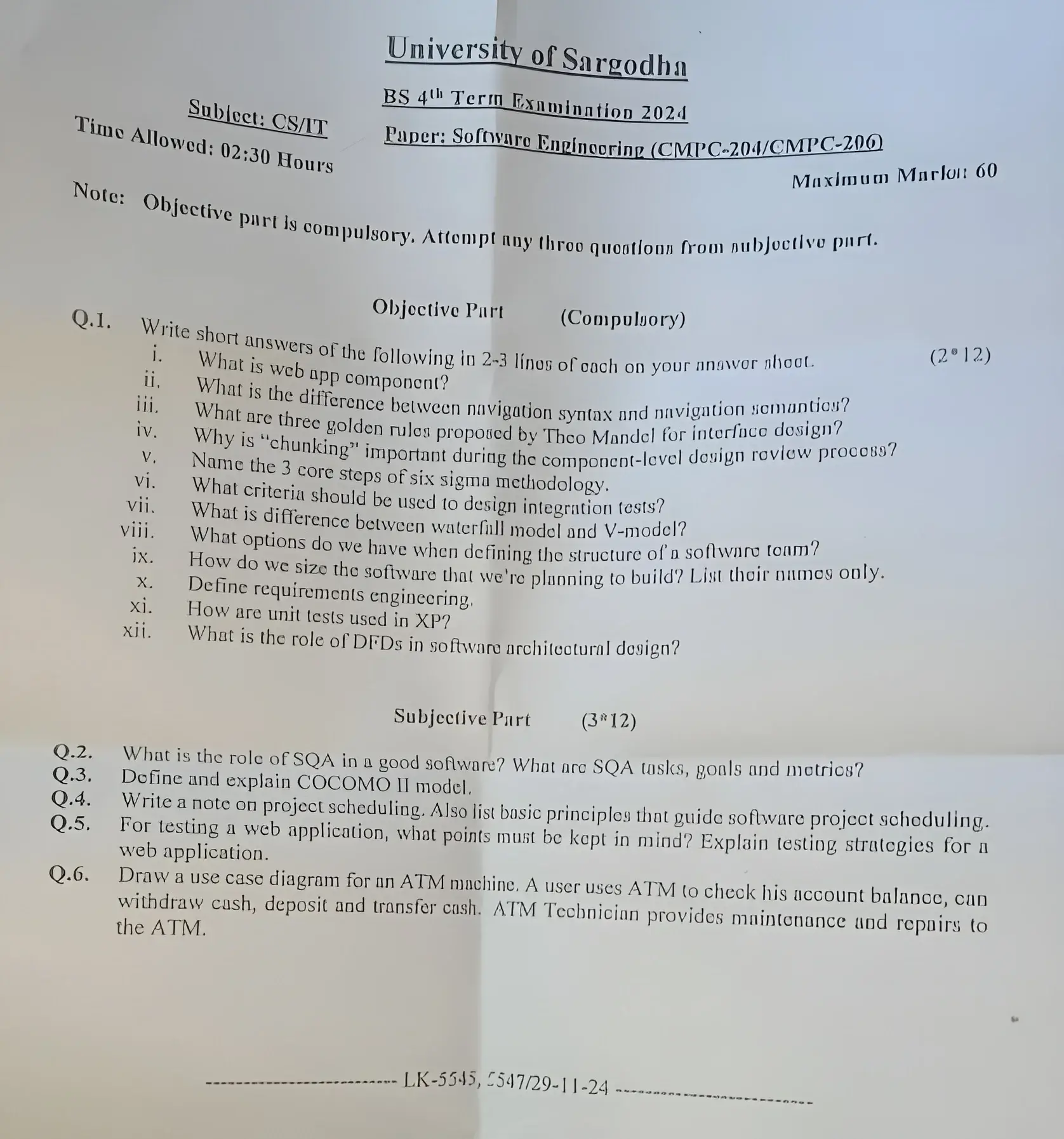
University: University of Sargodha (UOS)
Program: BS 4th Term
Subject: Software Engineering (CMPC-204 / CMPC-260)
Year: 2024
Time Allowed: 2 Hours 30 Minutes
Maximum Marks: 60
Why Use This Software Engineering Past Paper?
This Software Engineering past paper helps students understand real exam patterns, important theory questions, and commonly repeated concepts. It contains objective and subjective questions used in final university examinations.
- Revise core software engineering concepts
- Understand UML, SQA, COCOMO, and development models
- Prepare structured theoretical answers
- Improve exam writing and confidence
Software Engineering Past Paper 2024 (Complete)
University of Sargodha
BS 4th Term Examination 2024Subject: CS/IT
Paper: Software Engineering (CMPC-204/CMPC-260)Note: Objective part is compulsory. Attempt any three questions from subjective part.
Objective Part (Compulsory)
Q.1 Write short answers (2–3 lines each):
- What is a web app component?
- What is the difference between navigation syntax and navigation semantics?
- What are Theo Mandel’s golden rules for interface design?
- Why is chunking important in component review?
- Name three core steps of Six Sigma.
- What criteria should be used to design integration tests?
- Difference between Waterfall and V-Model?
- Options when defining software structure?
- How do we size software to be built?
- Define requirements engineering.
- How are unit tests used in XP?
- Role of DFDs in architectural design?
Subjective Part (Attempt any Three)
Q.2 Role of SQA, goals, tasks, and metrics.
Q.3 Explain COCOMO II cost estimation model.
Q.4 Write a note on project scheduling and principles of software scheduling.
Q.5 Web application testing strategies and key testing points.
Q.6 Draw and explain a use-case diagram for an ATM system.
Solved Short Questions (Toggle to View)
1. What is a web app component?
A web app component is a modular piece of a web application responsible for a specific function such as handling input, processing data, rendering UI, or communicating with the server.
Reference: MDN Web Docs
2. What is a web app component?
A web app component is a modular part of a web application responsible for a specific function such as UI, processing logic, or data management.
Reference: MDN Web Docs
3. What is the difference between navigation syntax and navigation semantics?
Navigation syntax describes how the navigation is written or structured (menus, links, icons). Navigation semantics describe the meaning and logic behind navigation — why users go where they go.
Reference: UX Design
4. What are Theo Mandel’s three golden rules of interface design?
- Place the user in control of the interface
- Reduce the user’s memory load
- Make the interface consistent
Reference: ACM Digital Library
5. Why is “chunking” important during component-level design review?
Chunking breaks complex information into smaller manageable sections, improving readability, comprehension, and reducing cognitive overload.
Reference: Interaction Design Foundation
6. Name the three core steps of Six Sigma methodology.
The three core steps (DMAIC model) are:
- Define
- Measure
- Improve
Reference: ASQ Six Sigma
7. What criteria should be used to design integration tests?
Integration tests should verify module interactions, data flow, interface consistency, error handling, and performance between components.
Reference: Martin Fowler
8. What is the difference between Waterfall model and V-model?
Waterfall is linear; testing starts after development. V-model is also sequential but testing activities are planned parallel to development phases.
Reference: SEBoK
9. What options do we have when defining the structure of a software team?
Common structures include:
- Centralized team
- Distributed team
- Hybrid or modular team
- Agile cross-functional teams
Reference: Scrum.org
10. How do we size the software we plan to build?
Software size is measured using Function Points, LOC (Lines of Code), or Use-Case Points. These help in cost and schedule estimation.
Reference: Software Metrics
11. Define requirements engineering.
Requirements engineering is the process of identifying, analyzing, documenting, validating, and managing user and system requirements.
Reference: IEEE Requirements Engineering
12. How are unit tests used in XP?
In Extreme Programming (XP), unit tests are written before code (TDD). They ensure small increments of code work correctly and remain stable during refactoring.
Reference: Extreme Programming
13. What is the role of DFDs in software architectural design?
DFDs show how data moves through the system, highlighting processes, data stores, and external entities — helping in clear system architecture planning.
Reference: Lucidchart
More solved answers will be added soon.
Download
Download Software Engineering Past Paper 2024 (PDF)
Exam Tips
- Relate theory with real-world examples
- Draw clear diagrams in use-case and DFD questions
- Explain models with advantages and limitations
- Practice time-bound writing
Related Past Papers
Parent Category: Past Papers