
Blog
Object Oriented Analysis and Design BSSE Term 4th Past paper 2017 UOS
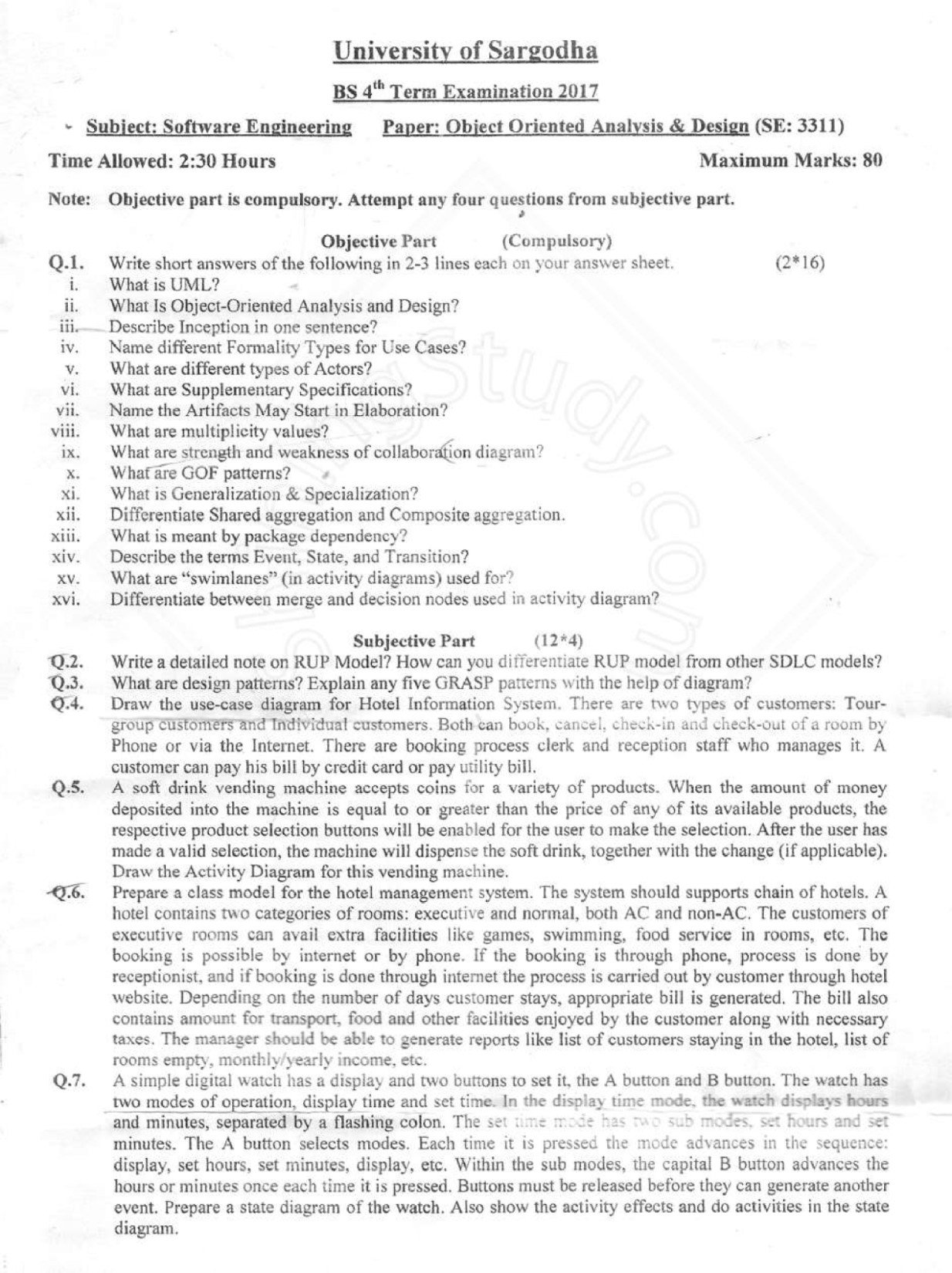
University of Sargodha
BS 4th Term Examination 2017
- Subject: Software Engineering
- Paper: Object Oriented Analysis & Design (SE: 3311)
- Time Allowed: 2:30 Hours
- Maximum Marks: 80
Note: Objective part is compulsory. Attempt any four questions from subjective part.
Objective Part (Compulsory)
Q.1. Write short answers of the following in 2-3 lines each on your answer sheet. (2*16)
i. What is UML?
ii. What is Object-Oriented Analysis and Design?
iii. Describe Inception in one sentence?
iv. Name different Formality Types for Use Cases?
v. What are different types of Actors?
vi. What are Supplementary Specifications?
vii. Name the Artifacts May Start in Elaboration?
viii. What are multiplicity values?
ix. What are strength and weakness of collaboration diagram?
x. What are GOF patterns?
xi. What is Generalization & Specialization?
xii. Differentiate Shared aggregation and Composite aggregation.
xiii. What is meant by package dependency?
xiv. Describe the terms Event, State, and Transition?
xv. What are “swimlanes” (in activity diagrams) used for?
xvi. Differentiate between merge and decision nodes used in activity diagram?
Subjective Part (12*4)
Q.2. Write a detailed note on RUP Model? How can you differentiate RUP model from other SDLC models?
Q.3. What are design patterns? Explain any five GRASP patterns with the help of diagram?
Q.4. Draw the use-case diagram for Hotel Information System. There are two types of customers: Tour-group customers and Individual customers. Both can book, cancel, check-in and check-out of a room by Phone or via the Internet. There are booking process clerk and reception staff who manages it. A customer can pay his bill by credit card or pay utility bill.
Q.5. A soft drink vending machine accepts coins for a variety of products. When the amount of money deposited into the machine is equal to or greater than the price of any of its available products, the respective product selection buttons will be enabled for the user to make the selection. After the user has made a valid selection, the machine will dispense the soft drink, together with the change (if applicable). Draw the Activity Diagram for this vending machine.
Q.6. Prepare a class model for the hotel management system. The system should supports chain of hotels. A hotel contains two categories of rooms: executive and normal, both AC and non-AC. The customers of executive rooms can avail extra facilities like games, swimming, food service in rooms, etc. The booking is possible by internet or by phone. If the booking is through phone, process is done by receptionist, and if booking is done through internet the process is carried out by customer through hotel website. Depending on the number of days customer stays, appropriate bill is generated. The bill also contains amount for transport, food and other facilities enjoyed by the customer along with necessary taxes. The manager should be able to generate reports like list of customers staying in the hotel, list of rooms empty, monthly/yearly income, etc.
Q.7. A simple digital watch has a display and two buttons to set it, the A button and B button. The watch has two modes of operation, display time and set time. In the display time mode, the watch displays hours and minutes, separated by a flashing colon. The set time mode has two sub modes, set hours and set minutes. The A button selects modes. Each time it is pressed the mode advances in the sequence: display, set hours, set minutes, display, etc. Within the sub modes, the capital B button advances the hours or minutes once each time it is pressed. Buttons must be released before they can generate another event. Prepare a state diagram of the watch. Also show the activity effects and do activities in the state diagram.