
Blog
Human Resource Management Past Paper 2024 (BS 4th Term – UOS)
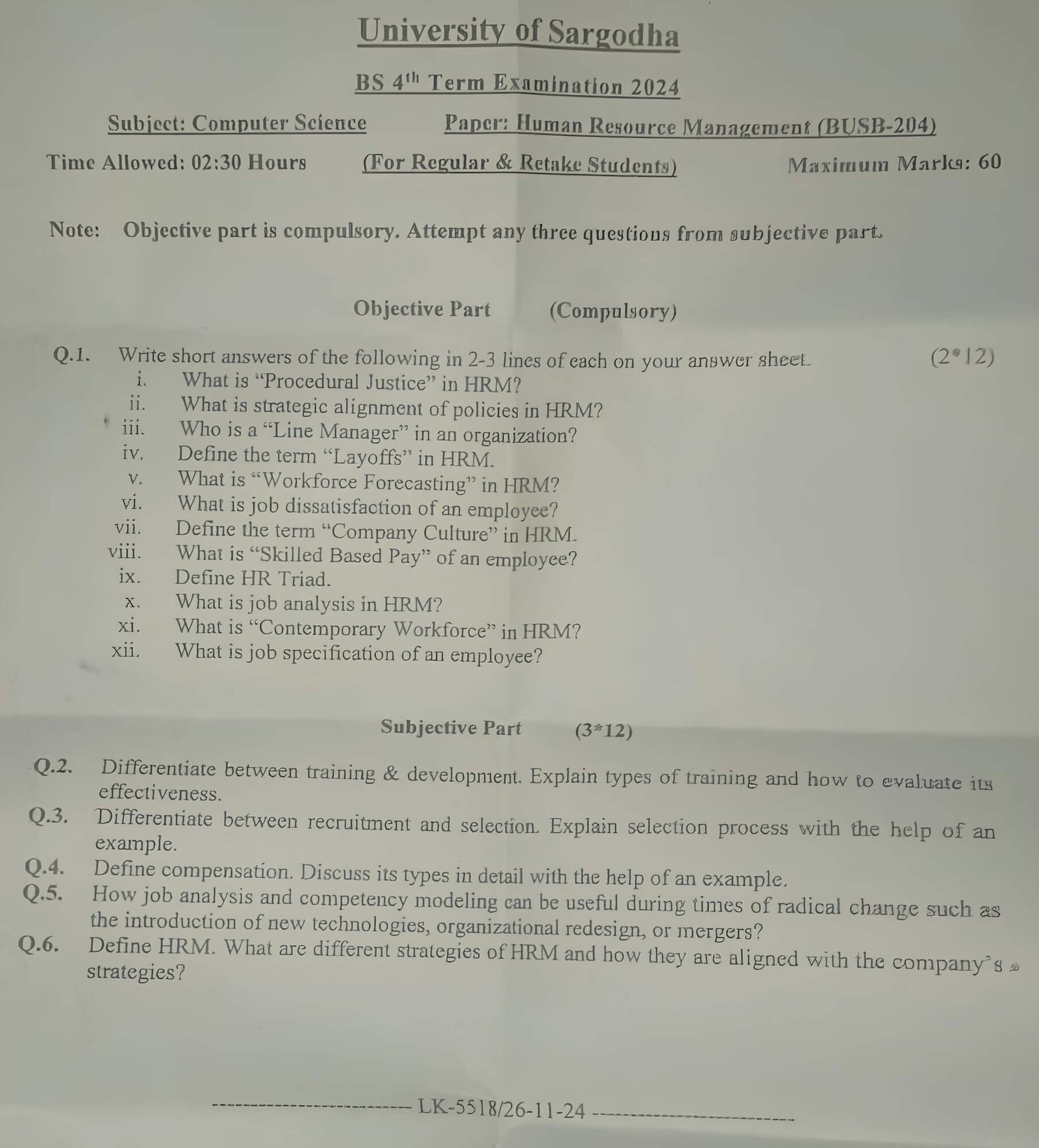
University: University of Sargodha (UOS)
Program: BS 4th Term
Subject: Human Resource Management (BUSB-204)
Year: 2024
Time Allowed: 2 Hours 30 Minutes
Maximum Marks: 60
Why Use This HRM Past Paper?
This Human Resource Management past paper helps students understand the final exam pattern, important questions, and commonly repeated concepts. It contains both objective and subjective questions.
- Practice short conceptual questions
- Understand key HRM definitions
- Prepare detailed answers for long questions
- Improve writing style and presentation
Human Resource Management Past Paper 2024 (Complete)
Below is the complete text of the paper:
University of Sargodha
BS 4th Term Examination 2024
Subject: Computer Science
Paper: Human Resource Management (BUSB-204)
Time Allowed: 02:30 Hours
Maximum Marks: 60
(For Regular & Retake Students)Note: Objective part is compulsory. Attempt any three questions from the subjective part.
Objective Part (Compulsory)
Q.1 Write short answers of the following in 2–3 lines each. (2×12)
- What is “Procedural Justice” in HRM?
- What is strategic alignment of policies in HRM?
- Who is a “Line Manager” in an organization?
- Define the term “Layoffs” in HRM.
- What is “Workforce Forecasting” in HRM?
- What is job dissatisfaction of an employee?
- Define the term “Company Culture” in HRM.
- What is “Skilled Based Pay” of an employee?
- Define HR Triad.
- What is job analysis in HRM?
- What is “Contemporary Workforce” in HRM?
- What is job specification of an employee?
Subjective Part (Attempt Any Three)
Q.2 Differentiate between training and development. Explain types of training and how to evaluate its effectiveness.
Q.3 Differentiate between recruitment and selection. Explain the selection process with the help of an example.
Q.4 Define compensation. Discuss its types in detail with the help of an example.
Q.5 How can job analysis and competency modeling be useful during times of radical change such as the introduction of new technologies, organizational redesign, or mergers?
Q.6 Define HRM. What are the different strategies of HRM and how are they aligned with the company’s strategies?
Download
Download HRM Past Paper 2024 (PDF)
Exam Tips
- Write short answers in clear points
- Use real-world examples in long questions
- Revise definitions and key concepts
- Practice time management
Related Past Papers
More past papers will be uploaded soon. Stay connected!
Objective Part – Short Questions (Solved)
Click each question to view the answer.
1. What is Procedural Justice in HRM?
Procedural justice means fairness in the processes that organizations use to make decisions such as promotions, discipline, or rewards. Employees judge fairness not only by outcomes, but by whether procedures were transparent and unbiased.Reference: SHRM – Procedural Justice
2. What is strategic alignment of policies in HRM?
Strategic alignment means HR policies are designed to support the organization’s mission, goals, and competitive strategy so employees’ work contributes directly to business success.Reference: Harvard Business Review – Strategy & Talent Alignment
3. Who is a Line Manager?
A line manager directly supervises employees, assigns work, evaluates performance, and ensures departmental goals are achieved.Reference: Investopedia – Line Manager
4. Define Layoffs.
Layoffs occur when employees are temporarily or permanently removed from jobs due to company downsizing, restructuring, automation, or financial problems — not because of poor performance.Reference: Indeed – Layoffs Explained
5. What is Workforce Forecasting?
Workforce forecasting is the process of predicting the number and types of employees an organization will need in the future.Reference: CIPD – Workforce Planning
6. What is job dissatisfaction?
Job dissatisfaction is a negative emotional response when employees feel unhappy with pay, working conditions, workload, management, or lack of growth opportunities.Reference: Psychology Today – Job Satisfaction
7. Define Company Culture.
Company culture is the shared values, behaviors, and beliefs that shape how employees interact, make decisions, and work together.Reference: Gallup – Company Culture
8. What is Skill-Based Pay?
Skill-based pay rewards employees according to the skills and knowledge they acquire — rather than only their job title.Reference: HR Help Board – Skill Based Pay
9. Define HR Triad.
HR Triad refers to the shared responsibility among HR professionals, line managers, and employees for managing people and performance.Reference: Springer – HR Roles
10. What is Job Analysis?
Job analysis systematically studies a job to determine duties, tasks, and the qualifications required to perform it effectively.Reference: SHRM – Job Analysis
11. What is Contemporary Workforce?
A contemporary workforce includes employees from different generations, backgrounds, cultures, and working styles (remote, hybrid, contract, etc.).Reference: McKinsey – Future of Work
12. What is Job Specification?
Job specification lists the education, experience, skills, and personal qualities needed to perform a particular job successfully.Reference: Indeed – Job Specification