
Blog
Computer Communication & Network Past Paper 2020 BS CS UOS
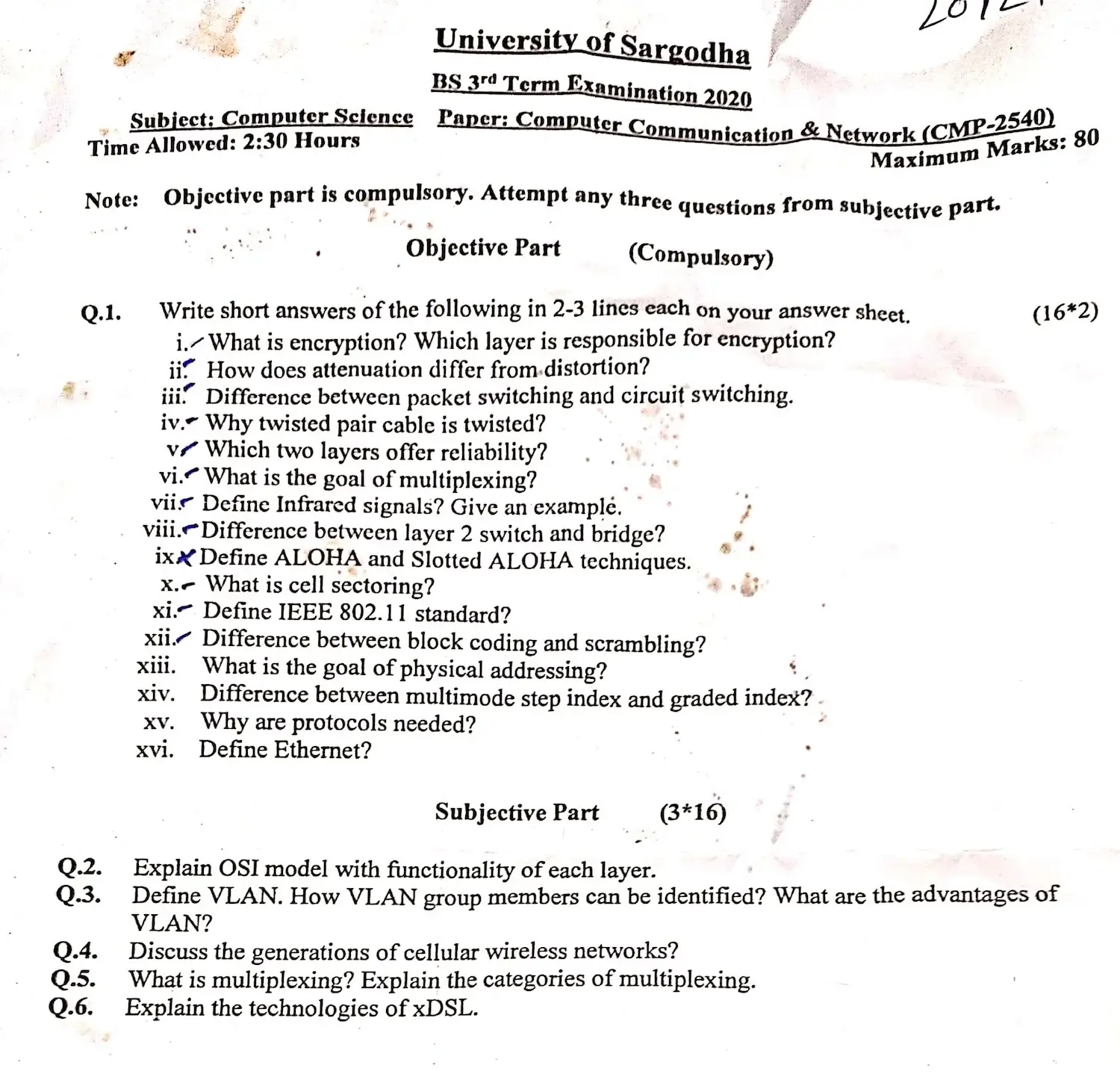
University: University of Sargodha (UOS)
Program: BS Computer Science
Subject: Computer Communication & Network (CMP-2540)
Year: 2020
Time Allowed: 2 Hours 30 Minutes
Maximum Marks: 80
You can also download the PDF of this paper here for offline preparation.
Why Use This Computer Communication & Network Past Paper?
This past paper helps students understand the exam pattern, frequently asked concepts, and short theoretical questions from networking fundamentals.
- Understand OSI and network layer concepts
- Practice short conceptual questions
- Prepare structured answers for theory questions
- Improve technical terminology and clarity
Computer Communication & Network Past Paper 2020 (Complete)
Below is the complete extracted text of the paper:
University of Sargodha
BS 3rd Term Examination 2020
Subject: Computer Science
Paper: Computer Communication & Network (CMP-2540)
Time Allowed: 02:30 Hours
Maximum Marks: 80Note: Objective part is compulsory. Attempt any three questions from subjective part.
Objective Part (Compulsory)
Q.1 Write short answers of the following in 2–3 lines each. (16×2)
- What is encryption? Which layer is responsible for encryption?
- How does attenuation differ from distortion?
- Difference between packet switching and circuit switching.
- Why twisted pair cable is twisted?
- Which two layers offer reliability?
- What is the goal of multiplexing?
- Define Infrared signals? Give an example.
- Difference between layer 2 switch and bridge?
- Define ALOHA and Slotted ALOHA techniques.
- What is cell sectoring?
- Define IEEE 802.11 standard?
- Difference between block coding and scrambling?
- What is the goal of physical addressing?
- Difference between multimode step index and graded index?
- Why are protocols needed?
- Define Ethernet?
Solved Objective Questions (Short Answers)
1. What is encryption? Which layer is responsible for encryption?
Encryption converts readable data into an unreadable form to ensure confidentiality. In OSI model, encryption is handled by the Presentation layer.
Reference: GeeksforGeeks – Presentation Layer
2. How does attenuation differ from distortion?
Attenuation is the loss of signal strength over distance, while distortion changes the shape of the signal due to different propagation delays.
Reference: GeeksforGeeks
3. Packet switching vs circuit switching
Packet switching sends data in packets over shared paths, while circuit switching establishes a dedicated path before transmission.
Reference: Cloudflare
4. Why twisted pair cable is twisted?
Twisting reduces electromagnetic interference and crosstalk between adjacent wires.
Reference: GeeksforGeeks
5. Which two layers offer reliability?
The Transport layer and Data Link layer provide reliability through error detection and correction mechanisms.
Reference: GeeksforGeeks
6. What is the goal of multiplexing?
Multiplexing allows multiple signals to share a single transmission medium efficiently.
Reference: GeeksforGeeks
7. Define Infrared signals
Infrared signals use electromagnetic waves for short-range communication such as TV remotes.
Reference: TechTarget
8. Layer 2 switch vs bridge
A Layer 2 switch is faster and supports multiple ports, while a bridge connects fewer LAN segments.
Reference: GeeksforGeeks
9. ALOHA and Slotted ALOHA
ALOHA allows transmission anytime, while Slotted ALOHA restricts transmission to fixed time slots to reduce collisions.
Reference: GeeksforGeeks
10. What is cell sectoring?
Cell sectoring divides a cell into sectors to improve capacity and reduce interference.
Reference: GeeksforGeeks
11. IEEE 802.11 standard
IEEE 802.11 defines standards for wireless LAN (Wi-Fi) communication.
Reference: IEEE
12. Block coding vs scrambling
Block coding adds redundancy for error detection, while scrambling randomizes data to avoid long sequences of 0s or 1s.
Reference: GeeksforGeeks
13. Goal of physical addressing
Physical addressing uniquely identifies devices on a local network using MAC addresses.
Reference: GeeksforGeeks
14. Multimode step index vs graded index
Step index has uniform refractive index, while graded index gradually changes refractive index to reduce dispersion.
Reference: GeeksforGeeks
15. Why are protocols needed?
Protocols define rules for communication to ensure reliable and structured data exchange.
Reference: Cloudflare
16. Define Ethernet
Ethernet is a LAN technology used for wired networking and data transmission.
Reference: TechTarget
Related Past Papers
Exam Preparation Tips
- Memorize short definitions clearly
- Draw diagrams where possible
- Use OSI layer mapping in answers
- Attempt objective part first